Journey into Silver's Past: A Resource for Collectors of Old Silver Bars
Delta Smelting and Refining
Delta was a prolific refiner out of Canada who produced beautiful ingots in all sizes. They are known for their pour character, dimples, pour lines, etc. I have been buying these whenever I can find a reasonable price, as premiums are very high on Delta bars and deservedly so. I’m pleased to share some great examples from my collection below.
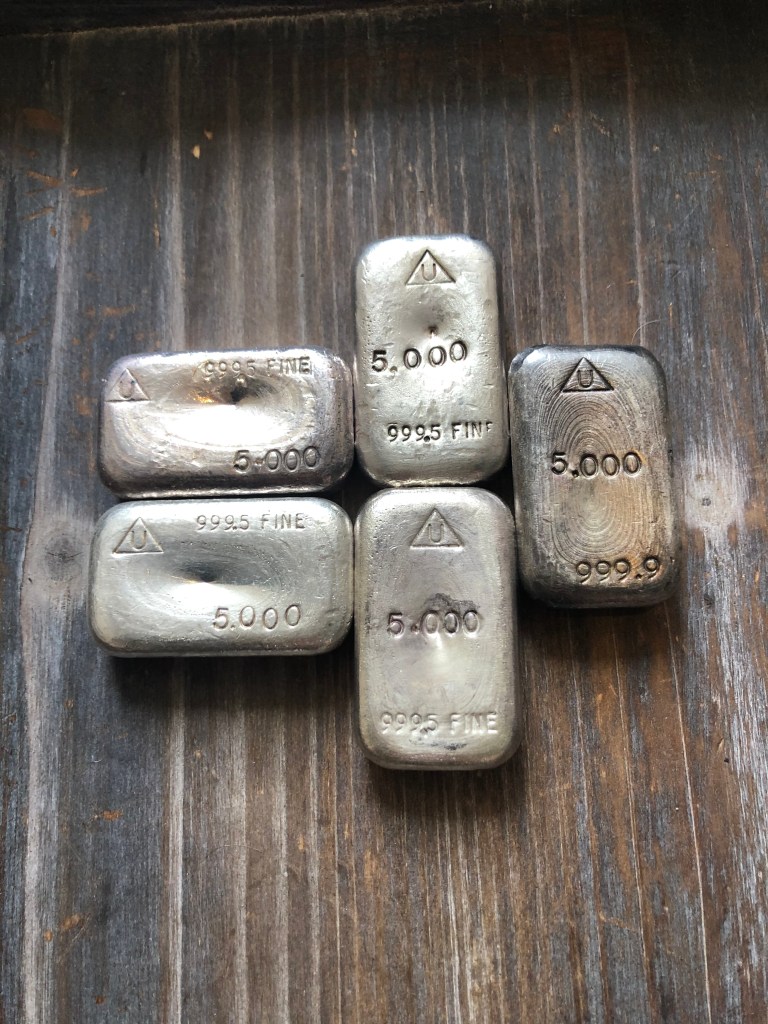
5 oz class with 3 varieties pictured. Notice purity differences from 9995 to 999. The 999.9 is hands down my favorite and the nicest 5 oz, I’ve come across. We say “permastack” when we acquire pieces like this.
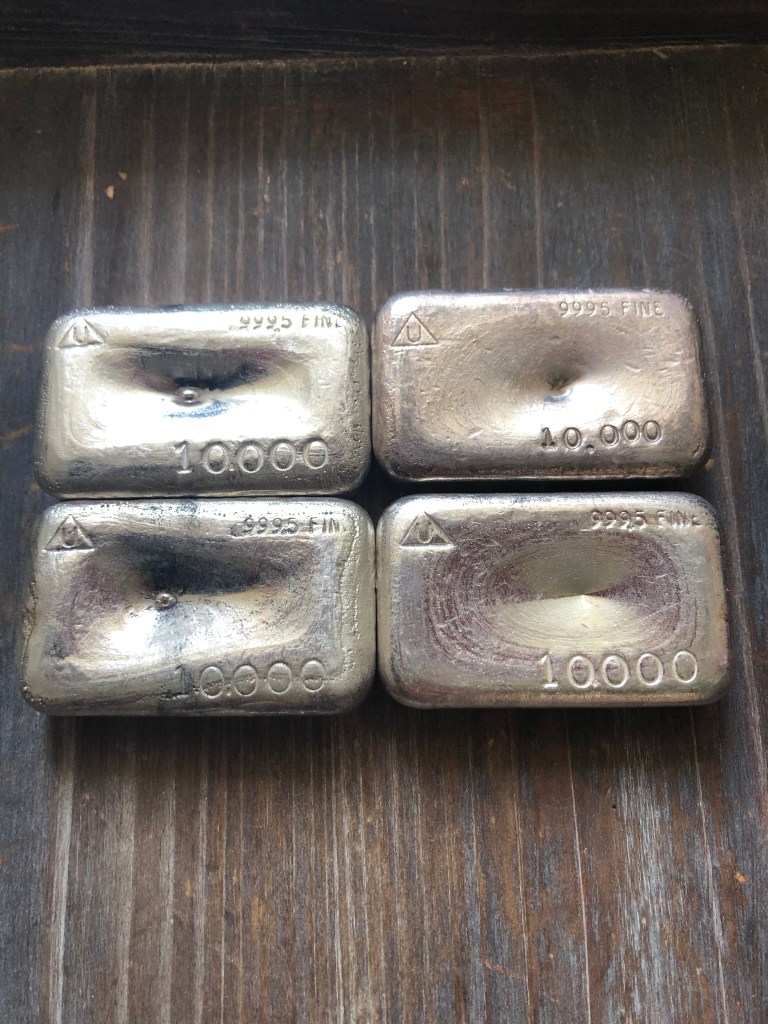
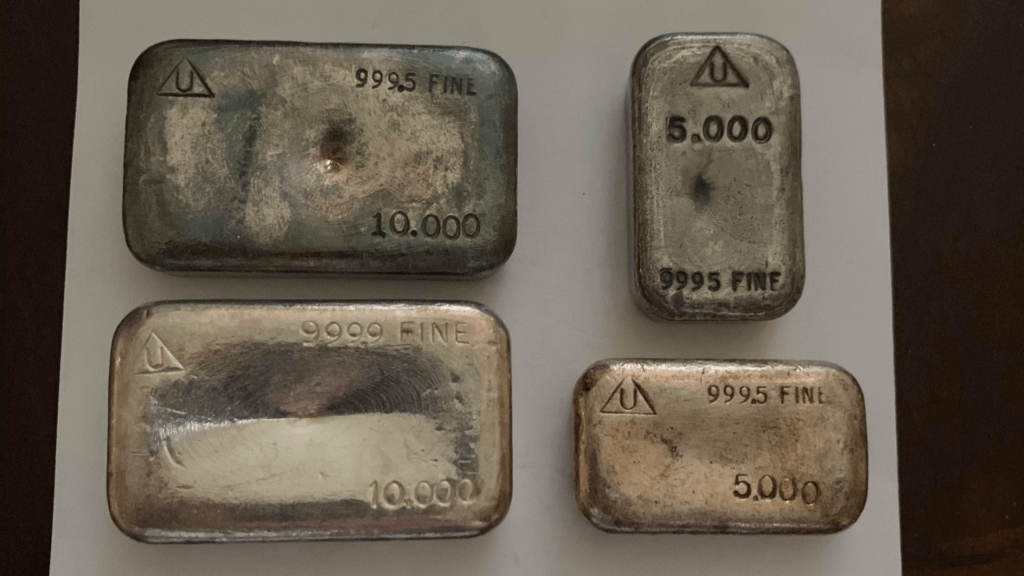
Not as rare as the 5 oz, but still particularly scarce are 10 oz class. Below are a few examples for your enjoyment.
Notice all bars are same with the exception of the small 10 oz stamp on top right ingot. The large 10s typically are more scarce, but I was fortunate to buy these from an LCS that had acquired from a collector.
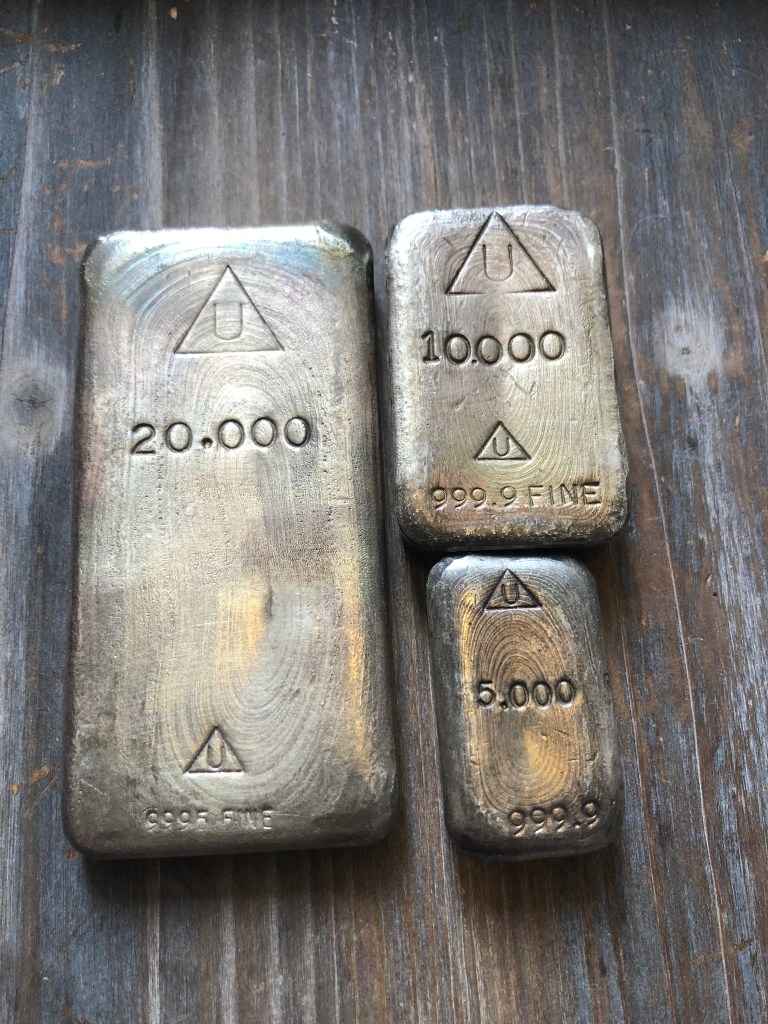
I saved a few beauties for the following picture. The 5 oz above paired with an incredible 20 oz and 10 oz double hallmark variety.
Family photo!Nice reverse pic. Purple toning going on around the back of the 20 oz.
Another share from my collector buddy, Brian R. He has several beautiful Delta pieces in his collection.
Note the small 10 variety bottom right is 999.9 fine. A more scarce purity to be found in 10 oz class.
Adding a really amazing historical image from the Delta office of Keith Law who has contributed more information on this famous old Canadian company than anyone previously. The insights of a long-term employee are invaluable.
This is Keith in his office at Delta in 1976. The image was used for the brochure producer, but if you notice shows the rejected bars to the left of him. Read his comments in this blog post for full context. Absolutely fascinating!
New blogger with a passion for old poured silver bars. I'm a Bay Area native and self employed. Active buyer of vintage silver poured bars and occasional seller.
View all posts by Vintage Poured Bars
28 thoughts on “Delta Smelting and Refining”
Can anybody please tell me what does the letter U mean inside the Triangle Delta logo stamped on Delta silver ingots…
I am one of the FIRST Delta Smelting employees, starting in 1969. I poured most of the bars you see here, up until 1978 when I left to start WESSEX REFINING..
The U is for the first permutation of the company: UNITED RESEARCH AND DEVELOPMENT, which was the company Dave Seed first started in processing ores using a so called “proprietary” procedure, which ultimately was a scam perpetrated to them. At that time, it was recognized that there was a good business model to start an actual small gold refinery, serving the large jewelry community in Vancouver, B.C.. I poured those bars constantly over those years!
I have in my possession the steel stamps for those bars, which I got when tasked with dismantling Delta Smelting after their terrible, 12,000,000.00 bankruptcy!
This is incredible information. I really appreciate the contribution here. Would love to connect with you on email. My email address is in the “Contact” section of the site. Would absolutely love to see any relics from your days working with Delta or Wessex. I have been wanted to add a Wessex piece to my collection for a long time. Not easy to find!
There will not be much at all from Wessex. We only survived for about 1.5 years of actual production. It took the financial company 6 months to wind down, I was long gone. Wessex died due to both disputes between management, and, the metal markets crashing from the HUNT BROS. Most of the silver and some gold bars I poured, went into the Seattle market, as we had a huge customer there dealing with and sending us silver scrap for return of metal. DELTA Smelting was still cranking out their bars after I left (1979), but not many, as they crashed into their 12 million dollar bankruptcy ( 26 million in today’s $) in April of 1983!
I have the WESSEX steel stamp used on the bars, an article from WESTERN MINER and a story I have written. Wessex was put into “voluntary liquidation” so all people were paid and I left again with my integrity intact, out to AJM in Aldergrove. The equipment was sold to ENGELHARD and as they were NOT going to finish the refinery being built in Tillbury Industrial park, it was sent to ENGELHARD in Aurora , Ontario. Wessex lived from Oct 79 to approx mid year of 1981.
I spent the summer of 1979…in a fellows garage , who would be our maintenance person, building, welding and fabricating most of the equipment, across from the PNE!
AJM was to be the next disaster in the gold refining business in the lower mainland, I have written extensively about my time there.
I have been surprised at the sites now that look for and covet the old poured bars, etc. during this last time period, as I have dragged out all my DELTA, ENGELHARD, AJM, things that I have kept. Quite amazed at what some things are selling for.
Funny to think that I am “Last Man Standing” in the precious metals world beginning here, 1969 to 2000, when Engelhard died and sold to TECHNIC. I worked at Technic till I retired in 2018.
The U is for the first permutation of the company: UNITED RESEARCH AND DEVELOPMENT, which was the company Dave Seed first started in processing ores using a so called “proprietary” procedure, which ultimately was a scam perpetrated to them. At that time, it was recognized that there was a good business model to start an actual small gold refinery, serving the large jewelry community in Vancouver, B.C.
Wow we have always put together snippets of history and the lineage of Delta and Wessex was unmistakable from the look feel and pour style. It’s great to get first hand experiences from your writing. Is people like you that make this hobby be able to fill in large voids of information. Thank you
Dan.s
As Delta morphed from ore processing to a viable refinery, and I was the first so to speak..”worker” I became the maker of both the gold and silver bars, and, as another learned skill, I/we began to supply gold and sterling casting grains into the Vancouver jewelry market, which was very large at the time.
Vancouver had two of Canada’s largest, large scale wholesale manufacturing plants in downtown Vancouver. They even supplied a lot of the WW II medal and other military buttons and add ons over the years.
Now, originally I made those chunky cubes and rectangular ingots that were actually cast into a mold. What a pain they were. if poured too hot and too fast, air bubbles would be trapped, which made the rejection rate unacceptable, plus, the weights were not always even close. Once the bars were knocked out and cooled, they would go a dedicated room with a band saw and belt sander, to cut and dress where the sprue was. This also made a huge mess of silver dust and filings, which made metal inventory control tough. We would process for two weeks and then clean the room, melt and try to reconcile inventory.
After about 2 years of that we of course then moved to machined, open face molds. This is the bulk of the Delta bars you see today. I would say I made 70% of all the Delta bars until I left in 1979.
Now, pouring an open face bar is actually no easy task, especially when it became another art to be learned. First thing was it took some time to actually pre-weigh enough silver, to allow for silver to volatilize during the melting phase, So, if you were doing a 100 troz, I would put in about 0.150 troz over, with hope that the bar would be JUST a hair heavy. Legally, the scale has to “turn the scale at the weight indicated”, on the bar. Next technical issue was, as the silver is molten, it absorbs oxygen in the furnace, which upon pouring the bar expels itself OUT of the cooling bar, messing up the top surface…called “sprouting”, fuzzy growths right out in the middle. How do we fix that?
Don’t forget there was no internet in the 70’s and and other refiners kept their secrets to themselves.
As I was producing almost 60% of the karat gold grains, 10, 14 & 18 Karat into the Vancouver market, I had developed a “Cover Gas” and soft nozzle design to keep oxidation from happening, during the pouring of the molten Karat into cold water. The alloy would be totally immersed in a mix of hydrogen and nitrogen gas till it went into the surface of the water. I scaled it up over the years big time to pour 100 troz of any Karat, as by the mid 70’s I was also supplying Seattle, which ate 100’s of ounces of Karat gold a week!
I made another special nozzle to softly flare this gas over the entire surface of the silver bar, till it went solid in the middle. Those little “ripples” you see in the bar are both from the gas and the vibration of the whole furnace room, subtlety vibrating my pouring table. We even had to make a SOLID piece of concrete, for the assay balance, that actually went through the floor, but not actually touching the building floor.
If you see that small dimple on the bottom, that was the dissolved gas trying to get out below. If a bar has a bit of “bubble” like holes in the bottom, that was due to the last round of bars being poured got too hot as they awaited their turn in the furnace. It was actually a fine line as to being too hot or too cold, as the silver/gold could start to “freeze” BEFORE it totally filled the mold and settled down to make a smooth surface.
Our molds were steel and treated with carbon black from an acetylene torch, to keep an interface of carbon between the steel and the molten metal, ever so important, as the molds got very hot during hours of pouring, even having to be put under a huge fan to help cool them. At ENGELHARD the molds were actually milled out of blocks of carbon, but they had a life span as the interior surface of the carbon mold did break down.
I would pour 2 x 100 troz, into a mold that had 2 forms in it. I had a days worth of pre-weighed bars in crucibles, ready to go. And, I would mix it up with 5’s, 10’s, 20’s. The 5 troz bar mold had 5 trays if you will.
I would spend my Mondays getting ready for the fine gold to come out of the refinery, to then add to my pre-made silver, copper and zinc mixes for a given karat. Tuesdays were then spent making all the gold alloys, packaging and the given to the sales reps to head to VANCOUVER AND SEATTLE. The rest of my week was making gold and silver bars and also in between some very custom alloys for the people that are now our high end jewelers in Vancouver. RAGNAR, TONY CAVELTI, ERIC LYTH, KARL STITTGEN, MARTHA STURDY and others. I made pink, green and even a BLUE gold. That was pretty cool, had some iron it in it and you heated it after, to turn it blue! I still have all my gold formulation sheets, seems such a shame they just sit in an almost 50 year old binder.
When you see an odd sized bar, say 6.023 for example, that was actually a “Return of Metal”. Lets say a jeweler, or a placer miner had a 20 troz bar of assayed gold and silver and the silver content was 6.023 troz, he could ask for that back in bar form, which we did as a service. Same with any odd sized gold bars. The customer might have had say 22.604 troz gold total, we would give back 2 by 10’s and then 2.604 in fine gold bars. Sometimes they would put silver to charges and others would pay the refining fee and take ALL metal back.
Lots of miners did NOT want to leave “metal on deposit” and that would be Delta’s ultimate downfall! For those that DID, there was NO gold or silver, to return when it came unglued. I have written that story which I may share at a later date. I have now been dragging out all my memorabilia, which is quite prodigious as I get to it. I have all 4 permutations of Deltas promotional sales brochures, of which yours truly is in the first ones. Funny to look back at my 25 year old self.
When Delta ended, I was tasked with taking it apart in January of 1984, to then take all the equipment to COSTA RICA, to build a refinery there for the Costa Rican government. That is when I got all the steel DELTA STAMPS and some of the tool steel dies for some of the 1 trox silver wafers, made by WESTERN MINT, Dave Seeds brother, and of course DELTA MINT, which was having PRESSED METAL PRODUCTS in Vancouver stamp out their wafers. I have a great picture of Dave Seed on the cover of B.C. BUSINESS magazine, with the products spread out on his desk.
DELTA SMELTING, WESSEX,., should never have gone down, but, it was never the employees that wrecked things, it was so called management, poor judgement, partners could not get along, trying to go too fast, and, not projecting a bit into the future…the WHAT IF scenario. No doubt none could have predicted the HUNT BROS. AJM Gold and Silver Refining Corp in Aldergrove, that was another whole different ballgame that ended in disaster in Dec of 1982, after I was there for only 1.5 years. That unused, unfinished refinery sits there to this day, millions and millions of dollars sitting there. I have written that story also.
ENGELHARD…who knows, such a big world wide company yet it finally succumbed, at least for my Richmond operation in the year 2000. It was finally taken over in the States by a hostile bid by BASF CHEMICALS in the year 2006.
NESMONT and then GOLDEN WEST were 2 other companies that tried in Vancouver. NESMONT went down with brass bars in the vault and a huge fraud. All these companies have marched into a sad history in some ways, a bad chapter in B.C. business. That I survived from 1969 to 2018, with my integrity intact and had employment in a crazy industry, still boggles my mind.
I hope this fills in some blanks and don’t hesitate if you have questions. I know what it is like to collect things and finding the history of said things is what the fun is all about!! Hope I have not rambled too much.
I read your very interesting history above- I have a question. After my Dad passed we found a precious metal deposit agreement from Delta Smelting and Refining Co for 900 ozs of silver purchased in Feb 1981 – is this null and void now?
It would be interesting to see the agreement as it stood in 1981?
FYI to All:
It was and still is, a common practice to hold metal in a pool account, metal on deposit if you will.
It saves a person from having to take physical metal and store/hide at home, or, a safety deposit box.
A 1,000 troz silver bar weighs approx 70 Lbs. So, those that thought they would be secure, should and when they want the metal back…OR SELL IT, it was but a phone call away.
A perfect case is a placer miner, who at the end of the season, with all bills paid, would leave their last few refining lots in their gold metal account. This was done so that at the beginning of the next placer season, they would phone and put in sell orders, to start the cash flow for that season.
Others, like your Dad, as an investment, were told the metal was secure and at one point, Delta offered to pay interest on the metal on deposit. This was an attractive option…no need to have 9 x 100 troz bars to deal with.
As people invested, in this case silver, it did not take long for a LOT of ounces, 1o,000’s of ounces, be on the BOOKS, but NOT as physical metal in the building.
Same with the gold in the case of miners, jewellers and the odd investor.
So, you can imagine, when the RUN started, and Delta was in the hole financially, they did NOT have the cash to even begin to buy physical metal off the market to service what people had in pool accounts.
In the very early days of Delta, there was enough metal as work in process, in the silver cells undergoing refining, to have met any returns. Same with gold. That quickly vanished from the mid 70’s till they died.
Even today, in the company I retired from in 2018, metal is held in pool accounts. One still has to have TRUST, that any demands can and would be met, for either metal return or $. As we did not make bars at Technic, we would return metal made by the ROYAL CANADIAN MINT, pretty awesome really, as it is a beautiful product(s) and recognized around the World.
Yes, it would more than be null and void. The fact that Delta had to declare bankruptcy on May of 1983, was due in a large part to the fact that when the “run” on people wanting their metal back, found that there was just not enough metal held in reserve to service the physical return. Simple as that. Plus, literally, the Company ceased to exist. That was the fundamental sadness of the demise, the very trust that Delta had established, was totally violated by using the customers metal that was “on deposit”, to use to borrow cash from the bank.
So sorry that happened! It took me years in the following years at Engelhard to re-establish the trust from miners, jewelers and others, that their metal held “on deposit” in what we called pool accounts, was truly safe and secure.
I think I have said, it did not even know there was such a collector group, a hobby if you will, of all things related to the old precious metals companies. That I was involved with at least 4 of them directly, and of course knowledge of NESMONT and GOLDEN WEST, can only be thankful that I can contribute to your site and knowledge.
That I got a call from a customer of mine looking, to see what I had saved from my time in the Industry, led me to actually go online and…WOW!
I have collected many things in my career, and, anything military, so I know what “collecting” is all about. With that goes the “want” of knowledge of…who..what…and where, things and people experienced or went through.
I have written many stories over the years of the scams and other interesting tidbits that I experienced, some involving MILLIONS of hard earned dollars. I would be glad to post up, if the collective thought that was appropriate for this site.
I am more than happy to answer any questions if I can too.
My best friend, who I have known since Grade 7, and became the SECOND employee of Delta Smelting, have now talked about what he has! He too went through the nightmares of the Industry in B.C. and unfortunately, suffered the downfall of Delta ALASKA, as he was running the melt facility there. A lot of Alaskan’s lost in the bankruptcy there also.
To elaborate on the run on Delta, 2 things occurred. There was a very large robbery here in downtown Vancouver, at what was basically a “safe” storage vault ( that was not so safe), over a weekend. What was in there, due to the U.S. not allowing citizens to own gold…was a vast amount of U.S. citizens gold, besides just normal jewellery and other valuables. As this was reported in the press, the story got distorted SOMEHOW, that this was part of Delta. At the same time, a jeweller in Calgary reported a huge loss from a refiner…misconstrued as Delta! In fact it was back east. The run was on to get money and gold/silver back from Delta.
The placer mining Industry in the Yukon was/is a very tight lipped group, BUT, at the same time, very cohesive group when it comes to the “Whole”, so it took only days for the news to spread. Same in the local jewellery business’s and, our large silver suppliers. We had ALL the movie and film labs for the most part, supplying us with their silver recovery cartridges and electrolytic flake when the technology changed. Then of course just the Mom & Pop’s that had invested in precious metals. That was not insubstantial.
The placer miners were beyond MAD and aggressive at the final meeting. Dave Seed had violated the very trust he promised to them.
That 12 million dollar bankruptcy was not small, in today’s dollars was around 26 million.
That I left Delta was a great, great sadness for me. Dave Seed was a personal friend and hunting partner long before the precious metals business. That the “moral compass” had shifted south, was of great concern for me, and of course the few others that left to start Wessex. It was not THAT that led to the downfall, but, at the time they could have gotten caught on what they were doing. We took the issue to the Board of Directors but were basically blown off, so the course was set for me and the others. I may at some point tell what was going on, but, at this point it serves no purpose.
As much as Dave Seed was President, his Dad, Harry Seed, also directed a LOT of things, some of which were not good in my opinion, and , as the company grew, others came in with GRAND plans, but had no idea of the original history of building that miners trust, nor, how HARD we all worked in the beginning to achieve that. History when LOST, causes these type of things to happen, and while you can’t stay the same, sometimes it IS BETTER to move slowly!!!!
Keith, what a great explanation to the practise of leaving precious metal “on account” it requires TRUST that is often broken by need or greed, when you think about it that TRUST is not much different from deposits we trust our banks with and SVB was a good example of a business entity using deposits in unwise investment’s using clients funds. The ensuing bank runs are not really any different then the same that happened to Delta on a more current and larger scale. Line you I would love to see that 1981 certificate as it’s part of the history of the times and Delta well after you left the company. Sad to see good trusting people loosing their money.
Dan.S
Hi Jacqueline,
Sadly Keith is Absolutly right but there are so many certificates that met the same fate… it’s sad
If you wouldn’t mind to share this certificate with me as I am working on a story on delta specifically and this certificate would be a good cornerstone in that.
Hope to hear from
You.
Dan smetana
Ottawa
Well this was incredible! What an amazing story I’ve got a delta 100oz bar and now pulled it out while reading this haha. To think you probably poured it 😂 thats awesome. Thanks for sharing I’ never knew much of the history of it until now so thank you sir!
Thanks for your comment, really appreciate that. It hit me, when I saw your post come in, that it is 40 years ago this year that Delta ended!
This year to date I have been going through my records of the time and basically have put together a book of my work history, news articles and other “ephemera” from the time. It has been an Interesting journey to say the least, when I see it all put together. 49 years in the business created quite the book.
If the site would like, I could post up one of my stories of HOW A REFINERY WORKS, with an addition of how you got your fine silver bars! The refining of the silver, like gold, is a multi-step process.
Hi Keith! How amazing to be able to ask the actual pourer of Delta bars questions! I would love to hear about any patterns or series you used when making Delta bars. As collectors, we look for things like 999.5 vs 999.9, or how many/size Delta triangle logos are on a bar, or Portrait vs Landscape molds, mold sizes in general, the CoAs and the Serials that start with letters A,B,C,D,E, F,G, etc. Thanks for sharing!
I took my time to gather some info before I answered the questions posed, so sorry to take a bit.
As memory fades over time, and we are now talking 40 – 50 years ago, I thought a phone call was in order to my friend and compatriot at Delta Smelting.
Tim, to answer your question…at no time in my tenure, nor
my friends, did we ever pour a 1,000.000 troz bar. IF one was ever done, it would have been a very special order and done towards the end of Delta, when I was long gone and my friend was running the Delta Alaska operation.
In the early days of Delta, we did not have really all that much silver to sacrifice to a 1,000 troz bar. Again, we would explain the reality to people that such a large bar…had to be sold in its entirety. It would weigh 70 lbs and require a good physical lift to move it and storage could be an issue. It also was very expensive, as silver, with fabrication, was between 50 – 60 dollars CDN. That would be say $55,000.00, no small amount then.
At the end, before it came unglued, Delta had some big U.S. customers supplying scrap, so it might be possible that the general furnace room gang got tasked with pouring a big one.
That would have been a relatively simple thing and beauty on a 1,000 ouncer was never an issue with ANY of the big refining companies. . Some of the ugliest 1,000 troz bars came from Engelhard, and their so called fine silver sometimes had a lot of contamination in them. We would melt them down; turn it into silver grain, which I would then make smaller denominations of bars.
In terms of the fineness question….
To get a certain purity, requires many steps, which of course adds a bit more cost…kind of.
In the early days of Delta, we had 1 reactor for silver dissolution and one for gold. We also were learning what it took to even get the silver up to 99.95, let alone 99.99, which came much later, in the new building. The fire in November of 1973, in the long run, prompted a LOT of changes to how things had been done. The “washing” of the electrolytic silver crystals had a few more steps introduced to help us get to 99.99
As far as we could remember, the 99.9 or, 999. was the standard for the most part. We could safely make 99.95. It was not till the mid 70’s that we changed to 99.99. We think/remember, that the standard changed, but, not as an industry standard but what we could honestly produce. I have a blank Delta gold assay certificate in front of me, #3887, it shows 999.5 for gold. Getting to 4’ 9”s is not easy when it comes to gold.
In a last brochure Delta did, again in my hands, sometime after I left, they still show the gold at 999.5. But, the 1 troz stamped wafers, on the front of the last brochure, show 999.9. That is because they bought fine gold sheet from either JM & M or Imperial, to then have those wafers stamped out by a local Vancouver Company, PRESSED METALS PRODUCTS, who have been out of business for a long time now, 2017. Pressed Metals also stamped the Western Mint wafers.
Assaying to the fineness requires some experience and proper lab/assay procedures. As you have seen, both RON CONNELL and RON WILLIAMS were B.C. Certified assays. Mr. Williams passed away many years ago now.
If Delta had actually ever achieved “Good Delivery” status, their bars would have been subject to random assay checks to make sure the ‘standard” was met.
Dave Seed was in the process of having gone to London with a 400.000 troz gold bar to seek that status.
All that being said, I do remember stamping silver bars at 99.99 .
Again, that being said, towards the end of my tenure, it was getting crazy to supply the market and I do vaguely remember some standards changing. This was ever the case when it came to karat gold’s, that’s another story of production nightmare.
There were 2 (two) only Delta triangle stamps, one large and one small. For what it is worth, we only had the one Wessex logo stamp.
Now, the biggy questions, the molds and numbering.
We first started with CLOSED molds, like a bullet mold if you will. The little square ones, the long rectangular ones and then the larger 100 troz, all done into molds that had a “sprue” that has to be cut off in a sealed room to trap the silver dust from cutting and grinding, I’m sure you have seen those. If you do, I and Evan made those. The molds would quickly over heat, so time was lost cooling them down. Then our new maintenance person came up with an idea for the 100 troz’s.
He welded a water jacket around the bottom. That sure helped but was it ever hot work taking the molds apart, carboning with acetylene black and re-assembling.
This bars started with the serial number system…A*** to 999, then onto B, etc.. This went the way of the dinosaur not long after the fire and when we moved to the new building. I think it really made no sense. Sure, maybe if you kept impeccable records and had an insurance loss and then recovery, but, as we had seen over all my years, the bad guys just melt stuff down to change it’s shape. It did seem scattershot at times, I have assay certificates that show serial numbers
Open faced, machined blocks were procured. No more fighting with locking tabs, carboning was easy and we could use my cover gas I developed. The other issue with those closed molds was they would both trap air, and have huge “sinks” at the top, which increased the rejection amount and they did not look pretty. They were WORK!
It was full speed ahead in the new building; I got to design my own office/work space. Due to that fact I was making all the bars….AND …the gold casting grains, my space was a sanctuary. I was not to be bothered on my alloy days and once I had my days bars all pre-weighed for melt I could then catch up on plant activity.
Here is a picture of myself, 1976, weighing out grain for some bars.
Oh…I see it will not let me post a picture, too bad!
If you look closely, the 100 troz bars have “sprouted”, which means the silver got too hot and upon cooling, expelled the excess oxygen, thus the bar is rejected. I would then re-weigh the bar, adding just the right amount of grain to top up the bar and allowing for volatilization of some silver. I would start with close to 0.200 troz extra, hoping the bar would be at just over a 100 troz; legally a bar had to roll the scale at the weight indicated. If you think about this, as the furnace got hotter through the day, and, that last bar of a 4 bar round in the furnace, would be getting that much hotter. If any you think is hot outside, try this. I would be staring into 2,000 degrees F. and on hot summer days the furnace room temp would be 45-55 (113 -131F) even hitting 60 (140F) a few times.
This was all at the cusp of digital scales, so time consuming
with the manual beam balance. The scale to my left was one of the first digitals, weighing in DWT (pennyweight) for my gold alloys, which sure made that process easier. That is my pocket watch collection in the back ground, another story.
In September, I will be showing pictures of the molds, if that is ok.
I will also write, if you would like to understand, that actual refining process for the very silver your bars are made of.
Keith, amazing history here. Send me the picture you want posted and I’ll throw it up on the site. We really appreciate your contributions to the community here. -Ryan
Keith, thanks so much for sharing all this, it all seems to make so much sense in hindsight once the puzzle is solved! The evolution to the poured bars without cutting and grinding, the evolution to 9999, the serial system, etc. If I understand correctly, starting from the first bars in 1969, they were generally all the square cubes until the fire in November of 1973. After that, the new building brought advancements of 9999 and a move away from the chunky cube style? Assuming all lettered serials were used from A to G and 1-999 that yields 7,000 bars. The non-lettered serials that often come sealed in a bag with Delta bars seem to go up to about 14000? Was there a reason some Deltas came with CoAs and were sealed in a bag? BTW, it’s a serious dilemma of mine on whether to break the seal on some of my favorite Delta bars! I’m sure it’s an impossible question, but of course curious how many Delta bars were ever produced. Also, where did the name Wessex come from? If you had to guess, how many bars do you think you were able to produce in total from Wessex?
Jeff, you have some good questions there, all of which have a series of history to go with them. As this site has really triggered my memories in so many areas, I might as well flesh them out for everyone.
WESSEX….where did that come from?
We will step back to the early beginnings of Delta, not 1966 but into 1969. Delta was processing ore and looking for platinum in the mountains in its beginning days.
As the business model was seen, to supply jewellery casting grains, a team of people was assembled. Dave Seed being the fearless leader, of course, then, an assayer, a chemist, office person, my friend and I were hired.
The chemist was the issue. And the issue was we could not find a person who actually had precious metals refining experience.
That led to a broader search, ultimately having a person, Tony B., emigrate to B.C. from England, where he had headed the platinum/palladium refining division of ENGELHARD U.K..
As much as refining gold is as ancient as the hills, to be trained by someone who had actually done it, was invaluable experience, than dancing through the dark with expensive and dangerous solutions.
It was Tony who got me going on refining gold and silver and the fundamentals of melting and making gold alloys. By 1970 I was pretty much on my own, with all of us working as a team to produce fine gold and silver, the karat alloys.
As more scrap came in, which of course started to include a lot of silver, the bar manufacturing began. In 1971 of course, when Nixon ended the gold standard, all metals started to move.
I won’t spend much time in this period; suffice to say we made a lot of silver product, of which I could not tell you how many bars I did. In the story I have sent your site moderator, that will give you a small idea. It was nothing I really paid attention to.
After the fire in November 1973 we started to use the open molds, but at what time exactly I do not remember. I do know that by the spring of 1976, it was full on open molds.
You have to know, that for us at the time, it was just a job. As the price of silver ramped up, some of which we bought/sold at 50 – 60 dollars an ounce, the FRENZY of people wanting to sell was insane!!!! People were lined up out our door into the parking lot, packing sterling silver that you cannot believe. What treasures!
The amount of Birks sterling we melted would make you cry again.
We also had all the film labs in town, plus the 2 large movie film developers of the time, and, the newspapers, hospitals, x-ray labs, etc..
You CAN rest assured that most of those bars you all have came from Birks sterling silver scrap, CDN coins and photo silver.
THEN….the coinage…..!
One time, in 1972’ish, a fellow came in one day, U.S. citizen, asking if we could handle coins. He said he would have around 3,000 ounces of MEXICAN coins, old pesos from the 20’s & 30’s.
Supposedly he had gotten a contract from the Mexican government to take the old coinage that was out of circulation. I think I still have a few he gave me. They were in the .720 to .900 fineness range I think.
He brought us three loads of silver and then said he would be back again in a few weeks. Never shows up. Then, we get a call from the RCMP, who had been contacted by a U.S. Federal agency. Seems our silver supplier was not only flying silver out of Mexico, in his DC-3, but loads of marijuana also. Turned out he augured into the Arizona desert in a crash landing, where they found some of our paperwork. That was a no-no big time back then and he went to jail.
People were investing in bags of coins and then come into sell. It was technically illegal to destroy coin of the Realm (CDN), but, as most silver coins of CDN mintage were out of circulation when silver was stopped mid 1968, a blind eye was turned as tons of coins got melted.
So, as the silver came in, we were going crazy making product.
On a good day, with no sidetracks, I could make 4 x 100 every hour…kind of. It would take an hour for the furnace to come up to temp, 4 crucibles in, approx an hour to melt to pouring temp. 1 ‘round” I would call it. Pour bars, reload crucibles. Then carefully bump the bars out onto the steel table, so as not to mark them, I would try to just catch the edge as it left the mold, to set gently on the cooling table. The cooling table would be wheeled under a large make-up air duct. Then I would go back to my office to get the next 4 pre-weighed silver charges. Back to the furnace room, grab the cooling cart and head back to my office to check weights/rejection. Back to the furnace room, for the next “round” of pours. By noon I could have had done 1,200 troz. Throttle furnace back for lunch hour and a break from the heat. Repeat process in afternoon…unless…..
In terms of fineness, we upped the grade of the silver anodes going into the electrolytic silver cells and the washing cycle of the silver crystals that involved, ammonia, alcohol, weak nitric, was added to ensure 9999. The furnace used to melt the silver crystals came under my bailiwick, as nothing else but pure metal and casting grain was allowed to be melted in it. It was kept like new, being rebuilt on a regular basis to make sure NOTHING dropped into a crucible. First thing I would do before firing the furnace was sweep the lid off (dust from the room), put a layer of bone ash in the bottom (to stop any sticking of the crucible) and make sure the underside of the lid was ok..
The tips of my crucible tongs got wire wheeled constantly, to make sure nothing was on them.
Then we must remember that I left in 78’ and Delta blasted along for almost 5 years, making silver bars by the 2 fellows it took to replace me. At the point that Delta failed, I was at the massive, secret refinery in Aldergrove, B.C., going through its death throws in the winter of 1982. THAT is a story!
Bars were only sealed in those bags if a customer asked, nothing special about them. You can see the bag sealer in the picture of my office. I’m sure you all have noticed that some bars have gotten quite gray looking, that is due to oxidation and the environment they lived in. Smokers were the worst when some bars came back for sale and the bars were black. Sulphur in the smoke or air.
That is also why, as the older generations that grew up with sterling silver, just got tired of polishing it.
At times, I could get sidetracked by sales coming, to tell me a customer was wanting to come the next day to pick up their silver, from scrap, or…
I would then shift to possible pouring a few 10’s, 20’s, who knew till I got the order, sometimes as you might have seen, the odd weight bar, which was exactly in the customers scrap and they pay for the charges. Usually silver was put to charges first, then any gold if required from jewellers lots.
My week was 2 days of fine gold and karat manufacture, then 3 of silver production, with fine gold bars thrown in as needed.
Now, I was totally independent then and Tony B. was actually doing platinum/palladium refining as a by product from all the jewellery scrap. He also set up a triple distilled mercury refining
Circuit, which would then be sold to industry and some back to the placer miners for placer gold fines recovery.
WESSEX….we are getting to that.
At a point, in 1978, a Delta sales person saw something going on that management was doing to customers!
It was at that juncture, Tony B.(chemist) Al B. (sales) Stan B. (Maintenance) and Gary T. (furnace room) + 3 other “investors”, left to start WESSEX REFINING in Steveston, B.C..
WESSEX was where Tony was from in England.
Wessex was also a Kingdom in the early days and I have often wondered if Tony thought that also, his kingdom. It did not take long, after a summer of hard work to literally build the plant and equipment and get running that the other partners started to have problems with Tony. That’s another story.
After many trials and tribulations, Wessex shut down when the metals markets blew up on the first round. At least we paid everyone off, no bad anything and I left with my integrity intact.
How many bars, I have no memory to even guess. We had a HUGE customer in Seattle, and all the scrap that came in was fed back to him in bars on a weekly basis. Each day was a blur, smelting jeweller’s sweeps, making casting grain and of course silver and some gold bars.
From my perspective at Wessex, I watched a partnership dissolve, metal markets crashing, and a manager who had NO IDEA how to hedge metal, kept building his own treasure chest of antique silver in the vault room, a new owner come in and then realize they had not a clue as to what they got into, then voluntary liquidation.
I hope that answered your questions and stay tuned for the moderator to post my actual story on Delta:
Death & Dismemberment
Thanks Keith, great story and information! It must have been quite something working in precious metals through the 1970s between happenings with Delta and Nixon. Never a dull moment!
NEVER A DULL MOMENT….sums it up. What the price increases drove people to sell was both sad, staggering at the volumes, and, what people actually LOST when the whole “Cash for Gold/Silver” thing came into being. That is a story I mention in my latest post here, that will tell of some of those
tales, and, the amazing treasures, bits of history, now gone into the very bars you have. It broke our hearts for my friend and I, who understood history, the craftsmanship, the wonderful works of art, now lost to the melting pot. We saved some, small articles at most, from the pots, with a “swap for metal” perk internal in the company. I have many pictures of the scrap, again maybe post some up if mod approves.


 Vintage Silver Bars
Can anybody please tell me what does the letter U mean inside the Triangle Delta logo stamped on Delta silver ingots…
LikeLike
We are currently circulating this question in the VPB group on Facebook.
LikeLike
I am one of the FIRST Delta Smelting employees, starting in 1969. I poured most of the bars you see here, up until 1978 when I left to start WESSEX REFINING..
The U is for the first permutation of the company: UNITED RESEARCH AND DEVELOPMENT, which was the company Dave Seed first started in processing ores using a so called “proprietary” procedure, which ultimately was a scam perpetrated to them. At that time, it was recognized that there was a good business model to start an actual small gold refinery, serving the large jewelry community in Vancouver, B.C.. I poured those bars constantly over those years!
I have in my possession the steel stamps for those bars, which I got when tasked with dismantling Delta Smelting after their terrible, 12,000,000.00 bankruptcy!
LikeLiked by 1 person
This is incredible information. I really appreciate the contribution here. Would love to connect with you on email. My email address is in the “Contact” section of the site. Would absolutely love to see any relics from your days working with Delta or Wessex. I have been wanted to add a Wessex piece to my collection for a long time. Not easy to find!
LikeLiked by 1 person
There will not be much at all from Wessex. We only survived for about 1.5 years of actual production. It took the financial company 6 months to wind down, I was long gone. Wessex died due to both disputes between management, and, the metal markets crashing from the HUNT BROS. Most of the silver and some gold bars I poured, went into the Seattle market, as we had a huge customer there dealing with and sending us silver scrap for return of metal. DELTA Smelting was still cranking out their bars after I left (1979), but not many, as they crashed into their 12 million dollar bankruptcy ( 26 million in today’s $) in April of 1983!
I have the WESSEX steel stamp used on the bars, an article from WESTERN MINER and a story I have written. Wessex was put into “voluntary liquidation” so all people were paid and I left again with my integrity intact, out to AJM in Aldergrove. The equipment was sold to ENGELHARD and as they were NOT going to finish the refinery being built in Tillbury Industrial park, it was sent to ENGELHARD in Aurora , Ontario. Wessex lived from Oct 79 to approx mid year of 1981.
I spent the summer of 1979…in a fellows garage , who would be our maintenance person, building, welding and fabricating most of the equipment, across from the PNE!
AJM was to be the next disaster in the gold refining business in the lower mainland, I have written extensively about my time there.
I have been surprised at the sites now that look for and covet the old poured bars, etc. during this last time period, as I have dragged out all my DELTA, ENGELHARD, AJM, things that I have kept. Quite amazed at what some things are selling for.
Funny to think that I am “Last Man Standing” in the precious metals world beginning here, 1969 to 2000, when Engelhard died and sold to TECHNIC. I worked at Technic till I retired in 2018.
LikeLike
The U is for the first permutation of the company: UNITED RESEARCH AND DEVELOPMENT, which was the company Dave Seed first started in processing ores using a so called “proprietary” procedure, which ultimately was a scam perpetrated to them. At that time, it was recognized that there was a good business model to start an actual small gold refinery, serving the large jewelry community in Vancouver, B.C.
LikeLike
Wow we have always put together snippets of history and the lineage of Delta and Wessex was unmistakable from the look feel and pour style. It’s great to get first hand experiences from your writing. Is people like you that make this hobby be able to fill in large voids of information. Thank you
Dan.s
LikeLike
Hello Dan and others.
Here is some history to help.
As Delta morphed from ore processing to a viable refinery, and I was the first so to speak..”worker” I became the maker of both the gold and silver bars, and, as another learned skill, I/we began to supply gold and sterling casting grains into the Vancouver jewelry market, which was very large at the time.
Vancouver had two of Canada’s largest, large scale wholesale manufacturing plants in downtown Vancouver. They even supplied a lot of the WW II medal and other military buttons and add ons over the years.
Now, originally I made those chunky cubes and rectangular ingots that were actually cast into a mold. What a pain they were. if poured too hot and too fast, air bubbles would be trapped, which made the rejection rate unacceptable, plus, the weights were not always even close. Once the bars were knocked out and cooled, they would go a dedicated room with a band saw and belt sander, to cut and dress where the sprue was. This also made a huge mess of silver dust and filings, which made metal inventory control tough. We would process for two weeks and then clean the room, melt and try to reconcile inventory.
After about 2 years of that we of course then moved to machined, open face molds. This is the bulk of the Delta bars you see today. I would say I made 70% of all the Delta bars until I left in 1979.
Now, pouring an open face bar is actually no easy task, especially when it became another art to be learned. First thing was it took some time to actually pre-weigh enough silver, to allow for silver to volatilize during the melting phase, So, if you were doing a 100 troz, I would put in about 0.150 troz over, with hope that the bar would be JUST a hair heavy. Legally, the scale has to “turn the scale at the weight indicated”, on the bar. Next technical issue was, as the silver is molten, it absorbs oxygen in the furnace, which upon pouring the bar expels itself OUT of the cooling bar, messing up the top surface…called “sprouting”, fuzzy growths right out in the middle. How do we fix that?
Don’t forget there was no internet in the 70’s and and other refiners kept their secrets to themselves.
As I was producing almost 60% of the karat gold grains, 10, 14 & 18 Karat into the Vancouver market, I had developed a “Cover Gas” and soft nozzle design to keep oxidation from happening, during the pouring of the molten Karat into cold water. The alloy would be totally immersed in a mix of hydrogen and nitrogen gas till it went into the surface of the water. I scaled it up over the years big time to pour 100 troz of any Karat, as by the mid 70’s I was also supplying Seattle, which ate 100’s of ounces of Karat gold a week!
I made another special nozzle to softly flare this gas over the entire surface of the silver bar, till it went solid in the middle. Those little “ripples” you see in the bar are both from the gas and the vibration of the whole furnace room, subtlety vibrating my pouring table. We even had to make a SOLID piece of concrete, for the assay balance, that actually went through the floor, but not actually touching the building floor.
If you see that small dimple on the bottom, that was the dissolved gas trying to get out below. If a bar has a bit of “bubble” like holes in the bottom, that was due to the last round of bars being poured got too hot as they awaited their turn in the furnace. It was actually a fine line as to being too hot or too cold, as the silver/gold could start to “freeze” BEFORE it totally filled the mold and settled down to make a smooth surface.
Our molds were steel and treated with carbon black from an acetylene torch, to keep an interface of carbon between the steel and the molten metal, ever so important, as the molds got very hot during hours of pouring, even having to be put under a huge fan to help cool them. At ENGELHARD the molds were actually milled out of blocks of carbon, but they had a life span as the interior surface of the carbon mold did break down.
I would pour 2 x 100 troz, into a mold that had 2 forms in it. I had a days worth of pre-weighed bars in crucibles, ready to go. And, I would mix it up with 5’s, 10’s, 20’s. The 5 troz bar mold had 5 trays if you will.
I would spend my Mondays getting ready for the fine gold to come out of the refinery, to then add to my pre-made silver, copper and zinc mixes for a given karat. Tuesdays were then spent making all the gold alloys, packaging and the given to the sales reps to head to VANCOUVER AND SEATTLE. The rest of my week was making gold and silver bars and also in between some very custom alloys for the people that are now our high end jewelers in Vancouver. RAGNAR, TONY CAVELTI, ERIC LYTH, KARL STITTGEN, MARTHA STURDY and others. I made pink, green and even a BLUE gold. That was pretty cool, had some iron it in it and you heated it after, to turn it blue! I still have all my gold formulation sheets, seems such a shame they just sit in an almost 50 year old binder.
When you see an odd sized bar, say 6.023 for example, that was actually a “Return of Metal”. Lets say a jeweler, or a placer miner had a 20 troz bar of assayed gold and silver and the silver content was 6.023 troz, he could ask for that back in bar form, which we did as a service. Same with any odd sized gold bars. The customer might have had say 22.604 troz gold total, we would give back 2 by 10’s and then 2.604 in fine gold bars. Sometimes they would put silver to charges and others would pay the refining fee and take ALL metal back.
Lots of miners did NOT want to leave “metal on deposit” and that would be Delta’s ultimate downfall! For those that DID, there was NO gold or silver, to return when it came unglued. I have written that story which I may share at a later date. I have now been dragging out all my memorabilia, which is quite prodigious as I get to it. I have all 4 permutations of Deltas promotional sales brochures, of which yours truly is in the first ones. Funny to look back at my 25 year old self.
When Delta ended, I was tasked with taking it apart in January of 1984, to then take all the equipment to COSTA RICA, to build a refinery there for the Costa Rican government. That is when I got all the steel DELTA STAMPS and some of the tool steel dies for some of the 1 trox silver wafers, made by WESTERN MINT, Dave Seeds brother, and of course DELTA MINT, which was having PRESSED METAL PRODUCTS in Vancouver stamp out their wafers. I have a great picture of Dave Seed on the cover of B.C. BUSINESS magazine, with the products spread out on his desk.
DELTA SMELTING, WESSEX,., should never have gone down, but, it was never the employees that wrecked things, it was so called management, poor judgement, partners could not get along, trying to go too fast, and, not projecting a bit into the future…the WHAT IF scenario. No doubt none could have predicted the HUNT BROS. AJM Gold and Silver Refining Corp in Aldergrove, that was another whole different ballgame that ended in disaster in Dec of 1982, after I was there for only 1.5 years. That unused, unfinished refinery sits there to this day, millions and millions of dollars sitting there. I have written that story also.
ENGELHARD…who knows, such a big world wide company yet it finally succumbed, at least for my Richmond operation in the year 2000. It was finally taken over in the States by a hostile bid by BASF CHEMICALS in the year 2006.
NESMONT and then GOLDEN WEST were 2 other companies that tried in Vancouver. NESMONT went down with brass bars in the vault and a huge fraud. All these companies have marched into a sad history in some ways, a bad chapter in B.C. business. That I survived from 1969 to 2018, with my integrity intact and had employment in a crazy industry, still boggles my mind.
I hope this fills in some blanks and don’t hesitate if you have questions. I know what it is like to collect things and finding the history of said things is what the fun is all about!! Hope I have not rambled too much.
Keith law
LikeLike
I read your very interesting history above- I have a question. After my Dad passed we found a precious metal deposit agreement from Delta Smelting and Refining Co for 900 ozs of silver purchased in Feb 1981 – is this null and void now?
LikeLike
I appreciate the note. Yes, this would be null and void. The company went bankrupt many years ago.
LikeLike
Thank you!!! Please keep writing your story. Very interesting!!!
LikeLike
Jacqueline,
It would be interesting to see the agreement as it stood in 1981?
FYI to All:
It was and still is, a common practice to hold metal in a pool account, metal on deposit if you will.
It saves a person from having to take physical metal and store/hide at home, or, a safety deposit box.
A 1,000 troz silver bar weighs approx 70 Lbs. So, those that thought they would be secure, should and when they want the metal back…OR SELL IT, it was but a phone call away.
A perfect case is a placer miner, who at the end of the season, with all bills paid, would leave their last few refining lots in their gold metal account. This was done so that at the beginning of the next placer season, they would phone and put in sell orders, to start the cash flow for that season.
Others, like your Dad, as an investment, were told the metal was secure and at one point, Delta offered to pay interest on the metal on deposit. This was an attractive option…no need to have 9 x 100 troz bars to deal with.
As people invested, in this case silver, it did not take long for a LOT of ounces, 1o,000’s of ounces, be on the BOOKS, but NOT as physical metal in the building.
Same with the gold in the case of miners, jewellers and the odd investor.
So, you can imagine, when the RUN started, and Delta was in the hole financially, they did NOT have the cash to even begin to buy physical metal off the market to service what people had in pool accounts.
In the very early days of Delta, there was enough metal as work in process, in the silver cells undergoing refining, to have met any returns. Same with gold. That quickly vanished from the mid 70’s till they died.
Even today, in the company I retired from in 2018, metal is held in pool accounts. One still has to have TRUST, that any demands can and would be met, for either metal return or $. As we did not make bars at Technic, we would return metal made by the ROYAL CANADIAN MINT, pretty awesome really, as it is a beautiful product(s) and recognized around the World.
LikeLike
Amazing history here, Keith!
LikeLike
Yes, it would more than be null and void. The fact that Delta had to declare bankruptcy on May of 1983, was due in a large part to the fact that when the “run” on people wanting their metal back, found that there was just not enough metal held in reserve to service the physical return. Simple as that. Plus, literally, the Company ceased to exist. That was the fundamental sadness of the demise, the very trust that Delta had established, was totally violated by using the customers metal that was “on deposit”, to use to borrow cash from the bank.
So sorry that happened! It took me years in the following years at Engelhard to re-establish the trust from miners, jewelers and others, that their metal held “on deposit” in what we called pool accounts, was truly safe and secure.
LikeLike
Keith,
You do have an amazing recollection of events. We need people like you in this hobby😉
LikeLike
Thanks for your comment. iccs222.
I think I have said, it did not even know there was such a collector group, a hobby if you will, of all things related to the old precious metals companies. That I was involved with at least 4 of them directly, and of course knowledge of NESMONT and GOLDEN WEST, can only be thankful that I can contribute to your site and knowledge.
That I got a call from a customer of mine looking, to see what I had saved from my time in the Industry, led me to actually go online and…WOW!
I have collected many things in my career, and, anything military, so I know what “collecting” is all about. With that goes the “want” of knowledge of…who..what…and where, things and people experienced or went through.
I have written many stories over the years of the scams and other interesting tidbits that I experienced, some involving MILLIONS of hard earned dollars. I would be glad to post up, if the collective thought that was appropriate for this site.
I am more than happy to answer any questions if I can too.
My best friend, who I have known since Grade 7, and became the SECOND employee of Delta Smelting, have now talked about what he has! He too went through the nightmares of the Industry in B.C. and unfortunately, suffered the downfall of Delta ALASKA, as he was running the melt facility there. A lot of Alaskan’s lost in the bankruptcy there also.
To elaborate on the run on Delta, 2 things occurred. There was a very large robbery here in downtown Vancouver, at what was basically a “safe” storage vault ( that was not so safe), over a weekend. What was in there, due to the U.S. not allowing citizens to own gold…was a vast amount of U.S. citizens gold, besides just normal jewellery and other valuables. As this was reported in the press, the story got distorted SOMEHOW, that this was part of Delta. At the same time, a jeweller in Calgary reported a huge loss from a refiner…misconstrued as Delta! In fact it was back east. The run was on to get money and gold/silver back from Delta.
The placer mining Industry in the Yukon was/is a very tight lipped group, BUT, at the same time, very cohesive group when it comes to the “Whole”, so it took only days for the news to spread. Same in the local jewellery business’s and, our large silver suppliers. We had ALL the movie and film labs for the most part, supplying us with their silver recovery cartridges and electrolytic flake when the technology changed. Then of course just the Mom & Pop’s that had invested in precious metals. That was not insubstantial.
The placer miners were beyond MAD and aggressive at the final meeting. Dave Seed had violated the very trust he promised to them.
That 12 million dollar bankruptcy was not small, in today’s dollars was around 26 million.
That I left Delta was a great, great sadness for me. Dave Seed was a personal friend and hunting partner long before the precious metals business. That the “moral compass” had shifted south, was of great concern for me, and of course the few others that left to start Wessex. It was not THAT that led to the downfall, but, at the time they could have gotten caught on what they were doing. We took the issue to the Board of Directors but were basically blown off, so the course was set for me and the others. I may at some point tell what was going on, but, at this point it serves no purpose.
As much as Dave Seed was President, his Dad, Harry Seed, also directed a LOT of things, some of which were not good in my opinion, and , as the company grew, others came in with GRAND plans, but had no idea of the original history of building that miners trust, nor, how HARD we all worked in the beginning to achieve that. History when LOST, causes these type of things to happen, and while you can’t stay the same, sometimes it IS BETTER to move slowly!!!!
As you can see….I like to write!
Keith Law
April 30, 2023
LikeLike
Keith, what a great explanation to the practise of leaving precious metal “on account” it requires TRUST that is often broken by need or greed, when you think about it that TRUST is not much different from deposits we trust our banks with and SVB was a good example of a business entity using deposits in unwise investment’s using clients funds. The ensuing bank runs are not really any different then the same that happened to Delta on a more current and larger scale. Line you I would love to see that 1981 certificate as it’s part of the history of the times and Delta well after you left the company. Sad to see good trusting people loosing their money.
Dan.S
LikeLike
Keith, how rare are the delta u 100oz bars? I am having a hard time with this search!
LikeLike
Hi Jacqueline,
Sadly Keith is Absolutly right but there are so many certificates that met the same fate… it’s sad
If you wouldn’t mind to share this certificate with me as I am working on a story on delta specifically and this certificate would be a good cornerstone in that.
Hope to hear from
You.
Dan smetana
Ottawa
LikeLike
Well this was incredible! What an amazing story I’ve got a delta 100oz bar and now pulled it out while reading this haha. To think you probably poured it 😂 thats awesome. Thanks for sharing I’ never knew much of the history of it until now so thank you sir!
LikeLike
Thanks for your comment, really appreciate that. It hit me, when I saw your post come in, that it is 40 years ago this year that Delta ended!
This year to date I have been going through my records of the time and basically have put together a book of my work history, news articles and other “ephemera” from the time. It has been an Interesting journey to say the least, when I see it all put together. 49 years in the business created quite the book.
If the site would like, I could post up one of my stories of HOW A REFINERY WORKS, with an addition of how you got your fine silver bars! The refining of the silver, like gold, is a multi-step process.
Keith Law
Aug. 4/23
LikeLike
Hi Keith! How amazing to be able to ask the actual pourer of Delta bars questions! I would love to hear about any patterns or series you used when making Delta bars. As collectors, we look for things like 999.5 vs 999.9, or how many/size Delta triangle logos are on a bar, or Portrait vs Landscape molds, mold sizes in general, the CoAs and the Serials that start with letters A,B,C,D,E, F,G, etc. Thanks for sharing!
LikeLike
Morning World!
I took my time to gather some info before I answered the questions posed, so sorry to take a bit.
As memory fades over time, and we are now talking 40 – 50 years ago, I thought a phone call was in order to my friend and compatriot at Delta Smelting.
Tim, to answer your question…at no time in my tenure, nor
my friends, did we ever pour a 1,000.000 troz bar. IF one was ever done, it would have been a very special order and done towards the end of Delta, when I was long gone and my friend was running the Delta Alaska operation.
In the early days of Delta, we did not have really all that much silver to sacrifice to a 1,000 troz bar. Again, we would explain the reality to people that such a large bar…had to be sold in its entirety. It would weigh 70 lbs and require a good physical lift to move it and storage could be an issue. It also was very expensive, as silver, with fabrication, was between 50 – 60 dollars CDN. That would be say $55,000.00, no small amount then.
At the end, before it came unglued, Delta had some big U.S. customers supplying scrap, so it might be possible that the general furnace room gang got tasked with pouring a big one.
That would have been a relatively simple thing and beauty on a 1,000 ouncer was never an issue with ANY of the big refining companies. . Some of the ugliest 1,000 troz bars came from Engelhard, and their so called fine silver sometimes had a lot of contamination in them. We would melt them down; turn it into silver grain, which I would then make smaller denominations of bars.
In terms of the fineness question….
To get a certain purity, requires many steps, which of course adds a bit more cost…kind of.
In the early days of Delta, we had 1 reactor for silver dissolution and one for gold. We also were learning what it took to even get the silver up to 99.95, let alone 99.99, which came much later, in the new building. The fire in November of 1973, in the long run, prompted a LOT of changes to how things had been done. The “washing” of the electrolytic silver crystals had a few more steps introduced to help us get to 99.99
As far as we could remember, the 99.9 or, 999. was the standard for the most part. We could safely make 99.95. It was not till the mid 70’s that we changed to 99.99. We think/remember, that the standard changed, but, not as an industry standard but what we could honestly produce. I have a blank Delta gold assay certificate in front of me, #3887, it shows 999.5 for gold. Getting to 4’ 9”s is not easy when it comes to gold.
In a last brochure Delta did, again in my hands, sometime after I left, they still show the gold at 999.5. But, the 1 troz stamped wafers, on the front of the last brochure, show 999.9. That is because they bought fine gold sheet from either JM & M or Imperial, to then have those wafers stamped out by a local Vancouver Company, PRESSED METALS PRODUCTS, who have been out of business for a long time now, 2017. Pressed Metals also stamped the Western Mint wafers.
Assaying to the fineness requires some experience and proper lab/assay procedures. As you have seen, both RON CONNELL and RON WILLIAMS were B.C. Certified assays. Mr. Williams passed away many years ago now.
If Delta had actually ever achieved “Good Delivery” status, their bars would have been subject to random assay checks to make sure the ‘standard” was met.
Dave Seed was in the process of having gone to London with a 400.000 troz gold bar to seek that status.
All that being said, I do remember stamping silver bars at 99.99 .
Again, that being said, towards the end of my tenure, it was getting crazy to supply the market and I do vaguely remember some standards changing. This was ever the case when it came to karat gold’s, that’s another story of production nightmare.
There were 2 (two) only Delta triangle stamps, one large and one small. For what it is worth, we only had the one Wessex logo stamp.
Now, the biggy questions, the molds and numbering.
We first started with CLOSED molds, like a bullet mold if you will. The little square ones, the long rectangular ones and then the larger 100 troz, all done into molds that had a “sprue” that has to be cut off in a sealed room to trap the silver dust from cutting and grinding, I’m sure you have seen those. If you do, I and Evan made those. The molds would quickly over heat, so time was lost cooling them down. Then our new maintenance person came up with an idea for the 100 troz’s.
He welded a water jacket around the bottom. That sure helped but was it ever hot work taking the molds apart, carboning with acetylene black and re-assembling.
This bars started with the serial number system…A*** to 999, then onto B, etc.. This went the way of the dinosaur not long after the fire and when we moved to the new building. I think it really made no sense. Sure, maybe if you kept impeccable records and had an insurance loss and then recovery, but, as we had seen over all my years, the bad guys just melt stuff down to change it’s shape. It did seem scattershot at times, I have assay certificates that show serial numbers
Open faced, machined blocks were procured. No more fighting with locking tabs, carboning was easy and we could use my cover gas I developed. The other issue with those closed molds was they would both trap air, and have huge “sinks” at the top, which increased the rejection amount and they did not look pretty. They were WORK!
It was full speed ahead in the new building; I got to design my own office/work space. Due to that fact I was making all the bars….AND …the gold casting grains, my space was a sanctuary. I was not to be bothered on my alloy days and once I had my days bars all pre-weighed for melt I could then catch up on plant activity.
Here is a picture of myself, 1976, weighing out grain for some bars.
Oh…I see it will not let me post a picture, too bad!
If you look closely, the 100 troz bars have “sprouted”, which means the silver got too hot and upon cooling, expelled the excess oxygen, thus the bar is rejected. I would then re-weigh the bar, adding just the right amount of grain to top up the bar and allowing for volatilization of some silver. I would start with close to 0.200 troz extra, hoping the bar would be at just over a 100 troz; legally a bar had to roll the scale at the weight indicated. If you think about this, as the furnace got hotter through the day, and, that last bar of a 4 bar round in the furnace, would be getting that much hotter. If any you think is hot outside, try this. I would be staring into 2,000 degrees F. and on hot summer days the furnace room temp would be 45-55 (113 -131F) even hitting 60 (140F) a few times.
This was all at the cusp of digital scales, so time consuming
with the manual beam balance. The scale to my left was one of the first digitals, weighing in DWT (pennyweight) for my gold alloys, which sure made that process easier. That is my pocket watch collection in the back ground, another story.
In September, I will be showing pictures of the molds, if that is ok.
I will also write, if you would like to understand, that actual refining process for the very silver your bars are made of.
Keith Law
August 20, 2023
LikeLiked by 1 person
Keith, amazing history here. Send me the picture you want posted and I’ll throw it up on the site. We really appreciate your contributions to the community here. -Ryan
LikeLike
Keith, thanks so much for sharing all this, it all seems to make so much sense in hindsight once the puzzle is solved! The evolution to the poured bars without cutting and grinding, the evolution to 9999, the serial system, etc. If I understand correctly, starting from the first bars in 1969, they were generally all the square cubes until the fire in November of 1973. After that, the new building brought advancements of 9999 and a move away from the chunky cube style? Assuming all lettered serials were used from A to G and 1-999 that yields 7,000 bars. The non-lettered serials that often come sealed in a bag with Delta bars seem to go up to about 14000? Was there a reason some Deltas came with CoAs and were sealed in a bag? BTW, it’s a serious dilemma of mine on whether to break the seal on some of my favorite Delta bars! I’m sure it’s an impossible question, but of course curious how many Delta bars were ever produced. Also, where did the name Wessex come from? If you had to guess, how many bars do you think you were able to produce in total from Wessex?
LikeLiked by 1 person
Afternoon World!
Jeff, you have some good questions there, all of which have a series of history to go with them. As this site has really triggered my memories in so many areas, I might as well flesh them out for everyone.
WESSEX….where did that come from?
We will step back to the early beginnings of Delta, not 1966 but into 1969. Delta was processing ore and looking for platinum in the mountains in its beginning days.
As the business model was seen, to supply jewellery casting grains, a team of people was assembled. Dave Seed being the fearless leader, of course, then, an assayer, a chemist, office person, my friend and I were hired.
The chemist was the issue. And the issue was we could not find a person who actually had precious metals refining experience.
That led to a broader search, ultimately having a person, Tony B., emigrate to B.C. from England, where he had headed the platinum/palladium refining division of ENGELHARD U.K..
As much as refining gold is as ancient as the hills, to be trained by someone who had actually done it, was invaluable experience, than dancing through the dark with expensive and dangerous solutions.
It was Tony who got me going on refining gold and silver and the fundamentals of melting and making gold alloys. By 1970 I was pretty much on my own, with all of us working as a team to produce fine gold and silver, the karat alloys.
As more scrap came in, which of course started to include a lot of silver, the bar manufacturing began. In 1971 of course, when Nixon ended the gold standard, all metals started to move.
I won’t spend much time in this period; suffice to say we made a lot of silver product, of which I could not tell you how many bars I did. In the story I have sent your site moderator, that will give you a small idea. It was nothing I really paid attention to.
After the fire in November 1973 we started to use the open molds, but at what time exactly I do not remember. I do know that by the spring of 1976, it was full on open molds.
You have to know, that for us at the time, it was just a job. As the price of silver ramped up, some of which we bought/sold at 50 – 60 dollars an ounce, the FRENZY of people wanting to sell was insane!!!! People were lined up out our door into the parking lot, packing sterling silver that you cannot believe. What treasures!
The amount of Birks sterling we melted would make you cry again.
We also had all the film labs in town, plus the 2 large movie film developers of the time, and, the newspapers, hospitals, x-ray labs, etc..
You CAN rest assured that most of those bars you all have came from Birks sterling silver scrap, CDN coins and photo silver.
THEN….the coinage…..!
One time, in 1972’ish, a fellow came in one day, U.S. citizen, asking if we could handle coins. He said he would have around 3,000 ounces of MEXICAN coins, old pesos from the 20’s & 30’s.
Supposedly he had gotten a contract from the Mexican government to take the old coinage that was out of circulation. I think I still have a few he gave me. They were in the .720 to .900 fineness range I think.
He brought us three loads of silver and then said he would be back again in a few weeks. Never shows up. Then, we get a call from the RCMP, who had been contacted by a U.S. Federal agency. Seems our silver supplier was not only flying silver out of Mexico, in his DC-3, but loads of marijuana also. Turned out he augured into the Arizona desert in a crash landing, where they found some of our paperwork. That was a no-no big time back then and he went to jail.
People were investing in bags of coins and then come into sell. It was technically illegal to destroy coin of the Realm (CDN), but, as most silver coins of CDN mintage were out of circulation when silver was stopped mid 1968, a blind eye was turned as tons of coins got melted.
So, as the silver came in, we were going crazy making product.
On a good day, with no sidetracks, I could make 4 x 100 every hour…kind of. It would take an hour for the furnace to come up to temp, 4 crucibles in, approx an hour to melt to pouring temp. 1 ‘round” I would call it. Pour bars, reload crucibles. Then carefully bump the bars out onto the steel table, so as not to mark them, I would try to just catch the edge as it left the mold, to set gently on the cooling table. The cooling table would be wheeled under a large make-up air duct. Then I would go back to my office to get the next 4 pre-weighed silver charges. Back to the furnace room, grab the cooling cart and head back to my office to check weights/rejection. Back to the furnace room, for the next “round” of pours. By noon I could have had done 1,200 troz. Throttle furnace back for lunch hour and a break from the heat. Repeat process in afternoon…unless…..
In terms of fineness, we upped the grade of the silver anodes going into the electrolytic silver cells and the washing cycle of the silver crystals that involved, ammonia, alcohol, weak nitric, was added to ensure 9999. The furnace used to melt the silver crystals came under my bailiwick, as nothing else but pure metal and casting grain was allowed to be melted in it. It was kept like new, being rebuilt on a regular basis to make sure NOTHING dropped into a crucible. First thing I would do before firing the furnace was sweep the lid off (dust from the room), put a layer of bone ash in the bottom (to stop any sticking of the crucible) and make sure the underside of the lid was ok..
The tips of my crucible tongs got wire wheeled constantly, to make sure nothing was on them.
Then we must remember that I left in 78’ and Delta blasted along for almost 5 years, making silver bars by the 2 fellows it took to replace me. At the point that Delta failed, I was at the massive, secret refinery in Aldergrove, B.C., going through its death throws in the winter of 1982. THAT is a story!
Bars were only sealed in those bags if a customer asked, nothing special about them. You can see the bag sealer in the picture of my office. I’m sure you all have noticed that some bars have gotten quite gray looking, that is due to oxidation and the environment they lived in. Smokers were the worst when some bars came back for sale and the bars were black. Sulphur in the smoke or air.
That is also why, as the older generations that grew up with sterling silver, just got tired of polishing it.
At times, I could get sidetracked by sales coming, to tell me a customer was wanting to come the next day to pick up their silver, from scrap, or…
I would then shift to possible pouring a few 10’s, 20’s, who knew till I got the order, sometimes as you might have seen, the odd weight bar, which was exactly in the customers scrap and they pay for the charges. Usually silver was put to charges first, then any gold if required from jewellers lots.
My week was 2 days of fine gold and karat manufacture, then 3 of silver production, with fine gold bars thrown in as needed.
Now, I was totally independent then and Tony B. was actually doing platinum/palladium refining as a by product from all the jewellery scrap. He also set up a triple distilled mercury refining
Circuit, which would then be sold to industry and some back to the placer miners for placer gold fines recovery.
WESSEX….we are getting to that.
At a point, in 1978, a Delta sales person saw something going on that management was doing to customers!
It was at that juncture, Tony B.(chemist) Al B. (sales) Stan B. (Maintenance) and Gary T. (furnace room) + 3 other “investors”, left to start WESSEX REFINING in Steveston, B.C..
WESSEX was where Tony was from in England.
Wessex was also a Kingdom in the early days and I have often wondered if Tony thought that also, his kingdom. It did not take long, after a summer of hard work to literally build the plant and equipment and get running that the other partners started to have problems with Tony. That’s another story.
After many trials and tribulations, Wessex shut down when the metals markets blew up on the first round. At least we paid everyone off, no bad anything and I left with my integrity intact.
How many bars, I have no memory to even guess. We had a HUGE customer in Seattle, and all the scrap that came in was fed back to him in bars on a weekly basis. Each day was a blur, smelting jeweller’s sweeps, making casting grain and of course silver and some gold bars.
From my perspective at Wessex, I watched a partnership dissolve, metal markets crashing, and a manager who had NO IDEA how to hedge metal, kept building his own treasure chest of antique silver in the vault room, a new owner come in and then realize they had not a clue as to what they got into, then voluntary liquidation.
I hope that answered your questions and stay tuned for the moderator to post my actual story on Delta:
Death & Dismemberment
Keith law
August 24, 2023
LikeLike
Thanks Keith, great story and information! It must have been quite something working in precious metals through the 1970s between happenings with Delta and Nixon. Never a dull moment!
LikeLike
Thank you Jeff,
NEVER A DULL MOMENT….sums it up. What the price increases drove people to sell was both sad, staggering at the volumes, and, what people actually LOST when the whole “Cash for Gold/Silver” thing came into being. That is a story I mention in my latest post here, that will tell of some of those
tales, and, the amazing treasures, bits of history, now gone into the very bars you have. It broke our hearts for my friend and I, who understood history, the craftsmanship, the wonderful works of art, now lost to the melting pot. We saved some, small articles at most, from the pots, with a “swap for metal” perk internal in the company. I have many pictures of the scrap, again maybe post some up if mod approves.
Keith law
August 30, 2023
LikeLike