When Things Go Wrong, by Keith Law

Thanks to Keith for sharing more stories in this post about his time at Delta. These stories are amazing for our readers to live vicariously through those in the thick of the refining business in the golden age of silver. Ok, enough from me!

FORWARD 

It was in 2015 that I wrote this story, being in the middle of documenting the companies and other things that went on in 

the refining Industry in B.C.. 

My friend Evan (2nd employee) and I would often reminisce  

about what we went through…and SURVIVED. 

You have to realize, we did everything in those early days, wiring, gas pipe fitting, re-building furnaces, plumbing, and maintenance!  Very rarely did we call trades in, can you imagine doing all that now….doing self taught 3 phase wiring….ha. 

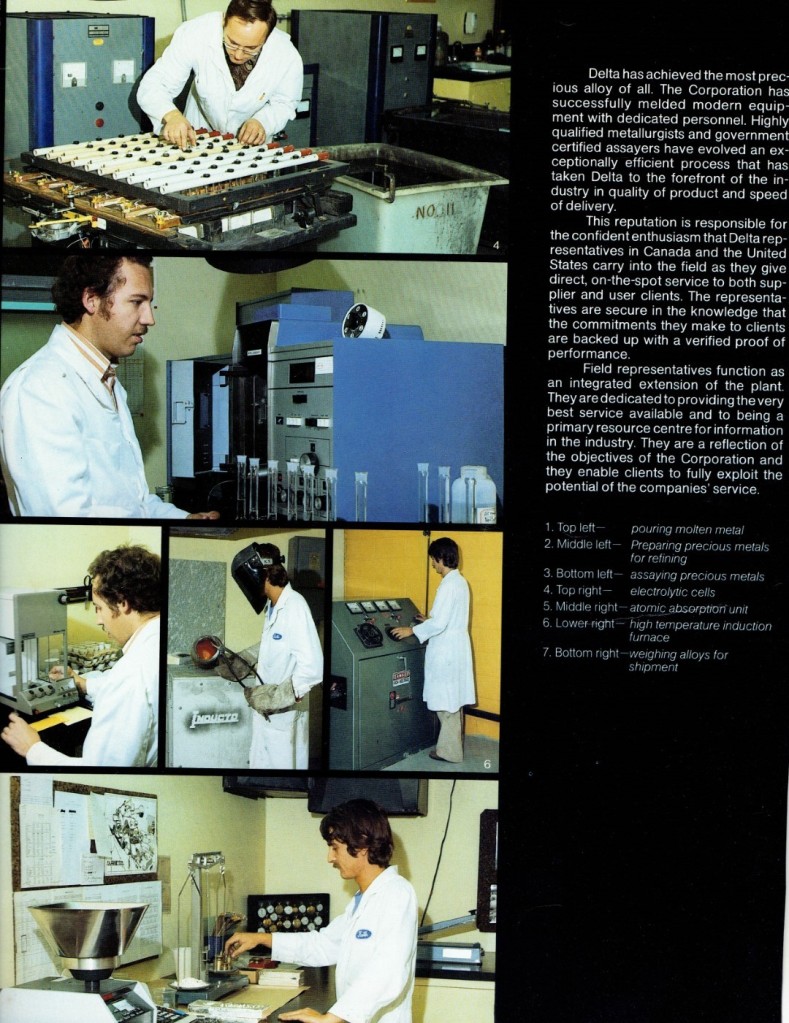
We also worked with a ton of very dangerous chemicals, nitric acid, hydrochloric acid, sulphuric acid, alcohol, ammonia. We used the extremely dangerous hydrofluoric acid to clean gold nuggets. Our dry chemicals for melting were Borax anhydrous, dense soda ash, potassium nitrate and a few others goodies, not good to breathe. The mercury refining alone presented some serious concerns for processing. 

When Delta moved to the new building, all that was behind us, 

my world became the alloys and investment bars totally. But, we both learned skill sets that stayed with us, being able to stay safe as the years went by. 

And at that, a lesson would occasionally remind us of how quickly something can go bad. We had poured a new lid for one of the smaller furnaces, likely weighing close to 200 lbs. We had set it in place, which meant the lid pivot pipe had been slid down onto the receiving pipe, fastened to the furnace body. The process was to SLOWLY increase the heat to begin the drying process, which normally takes a day of running. The lid was left 1” up from the furnace body. Anyone of us would watch for any sign of steam, then shut the heat off till it stopped steaming, re-fire and repeat. That was to continue all day till we felt we could go full throttle with heat. 

About an hour after starting the furnace, I was in my alloy room and Evan was in the silver room. A tremendous BOOM and then heavy crash was heard from the furnace room. We both arrived at the same time. The lid had exploded, a “steam spall”, blowing the lid up off the pipe and throwing itself across the room. Scary if anyone had been in there. There was high temp cement everywhere, the lid ruined. To think the force required to fire that 200 lbs of cement and steel across the room….WOW! 

We could only think that there was a large air pocket that got trapped during the lid cast and for whatever reason did not get out. In subsequent rebuilds, we would use our small jackhammer as a vibrator, like the concrete industry does, to get those bubbles out. We had to teach ourselves the best water/cement mix to use on this 3,000 F refractory cement. 

So, we did survive, our arms do show the years of small radiant heat burns, even through our safety clothing. We learned to touch NOTHING till we checked if it was hot or not. Dave Seed’s brother came into the furnace room one day, spying a nice gold bar I had just poured and bumped out, before I could say anything, he grabbed the bar……. 

Read on for the early days on Shell Road, before moving to Cambie Road…. 

Keith Law 

Aug 30, 2023 

I thought as a shift from the scam stories, I would write about the beginning days of the precious metals refining business in B.C., and my personal experience of ……. 

                        WHEN THINGS GO WRONG 

In a blink of bright orange flame and an ear ringing explosion, the white, five gallon plastic bucket ceased to exist in its present form. 

Lets step back a minute here, it’s the early 70’s, in a brand new industry on the West Coast. There were two of us to start, as the original employees, in our early 20’s. Then, after a few years, we hired some graduating chemistry students from B.C.I.T. . Now imagine you have access to all sorts of wonderful chemicals and gasses that can go BOOM! What 20 year old would not think that was a dream come true? 

Over those early years I had to experiment with different cover gases during the pouring process for bullion bars. I was in charge of all the bullion production at that time and as the markets started rise, so did sales of investment products, mainly silver. This was the start of the silver rush culminating in the HUNT BROTHERS     

(https://en.wikipedia.org/wiki/Silver_Thursday)    

getting caught in their speculation and the market grenading into oblivion. 

I had come up with a mix of argon and hydrogen gas, to be played over the surface of the cooling bar, giving it a nice, finished looking surface. Now, hydrogen burns with a bright orange flame and in a confined space, under the right conditions, it will explode. Our young 20 year old minds thought it would be cool to see how HIGH we could launch a 5 gallon plastic bucket if we filled it with hydrogen. Our first refinery was in an undeveloped area of Richmond, where we had no neighbours to annoy, although over time we got on a first name basis with some of the Richmond fire department personnel…more on that later. 

So imagine 3 of us standing outside, with a 5 gallon white plastic bucket turned upside down and a line running from our hydrogen bottle, with a tap on the end. We gave it a shot of hydrogen, and of course hydrogen being lighter than air, it would have gone to the top of the bucket. Harry, who was a smoker, had a lit cigarette hooked at the end of a straightened out coat hanger.  He gently pushed it under the lip of the bucket and in a second or two there was a small WHUMP and the bucket maybe went 2 feet in the air. COOL! Ok, so we need more hydrogen, operating under the principle:  if some is good…more is better! Another good shot of hydrogen, repeat procedure, WHUMP, bucket goes maybe 4 feet in the air. Right, so we now think we need to really fill this thing up. Our objective is to try to get the bucket to fly as high as our vault, some 15 feet high. I turn the tap on, letting the gas run for 15 seconds or so. I step back…good thing, as Harry stretches his arm out, with the lit cigarette, trying to be as far away as possible. Just as the glowing end of the cigarette got close to the edge of the bucket..KABOOM…think the Hindenburg here, a monstrous orange flame, an ear ringing explosion, the white plastic bucket did not go up so much as it just seemed to disappear into a million white shards of plastic shrapnel, blowing the 3 of us off our feet, and singeing all the hair on Harry’s face. That was the last time we tried that little experiment. 

As we had a complete lab, I think we had most of the chemicals required to make some very dangerous things. At the time, we were developing a copper recovery system, doing mercury refining and slowly trying to figure out how to get the silver out of silver oxide batteries.  

In line with that one day it came upon us that we could make a pressure sensitive explosive in small quantities. It required a certain chemical to be filtered over iodine crystals and then left to dry. We would sprinkle the crystals on the floor, then, jump on them. There would be a small BANG and a little cloud of purple gas would come up. We thought that was hysterical. We had gotten to the point that we had hired a secretary/bookkeeper. The office she worked in was some 50 feet from the washroom, with a concrete floor in between. Someone…not me…came up with the brilliant idea to sprinkle a trail of crystals from the office to the washroom, so when the secretary came out….. 

She came out of the office in her high heels, thus having an even greater pressure on the crystals, due to the small contact area. The first little bang had her confused as to what happened, then another, then another, all with greater clouds of purple gas. She started to run to the washroom…BAD idea…bang’s went to small booms, then a staccato, of small explosions, all accompanied by an ever increasing cloud of purple gas. We of course were in hysterics, but the language coming out of the washroom was not to be forgotten, and the threat of physical harm had us putting that little joke away! 

On a more serious note, things did go bad over time. We had a couple of people who had no sense of safety, leading to some serious accidents, our first being an accident with nitric acid by our assayer, Barry. He just seemed plain accident prone, lighting the gas assay furnace after the gas had run too long before an actual flame was applied. He blew the door off the assay muffle furnace a few times; luckily he was not in front of it. I had to put my foot down and tell him he was not allowed to start the furnace, one of us would. 

One morning, he had to re-fill a nitric acid bottle from a keg of nitric, which for you to imagine is basically a beer keg size. There was a small hand pump in the drum, with a spigot that curved down to fill a bottle. He went to the drum WITHOUT his safety shield on, only his glasses. He must have been in a bit of a rush and gave the pump a faster pull and push. The spigot blew off and he got a full stroke of nitric acid right in his face. I was in the lab at the time and all I heard was a scream, then he came running though the door to the lab. His face, hair and shoulders were smoking, white fumes just boiling off him. Think of every horror movie you may have seen. One thing I have been blessed with my whole life is the ability to think fast on my feet. I grabbed him and dragged him to our lab sink, pushing his head down while I turned the tap on. My partner ripped Barry’s shirt off, which was soaked in nitric, still cooking his neck and shoulders. I was worried about drowning him!  

As Richmond was still very small then, I decided I would rush him to the hospital, as getting an ambulance then would just have taken too long. I was just getting into car racing then and had a very high performance oriented car, so we threw him into my passenger seat and off we went. I must have been doing around 80 MPH on Westminster Highway when an RCMP car hits his lights behind me…for speeding. I climb on the brakes and stop, he comes over, obviously ready to give me a ticket, I say; “Industrial accident, with acid!” He took one look at Barry and says: “Follow me!” I did the last 2 miles with a police escort. 

Barry survived with minimal face scarring, which is a miracle. His glasses saved his eyes and his reflex action had his eye lids closed, so only they got some burning. His neck and ears got scarred, as the shirt held the nitric against his skin. As we all had long hair on the early 70’s, the hair over his ears also held the nitric in, burning the tips severely. I shudder to think what he would have looked like if that sink had not been so close. 

His final accident, before he quit, was he put a ladder up against the wall of the lab. He wanted to go up on the sub-ceiling to check our water still. He had the base of the ladder likely 8 feet away from the wall, so you know that is not going to work. Just as he got to the top of the ladder, some 8 feet up, the ladder base just kicked out, and he slid down the wall, screaming all the way. His hands of course are clutching the sides of the ladder, so when it hit the ground, it both knocked the wind out of him and PINCHED his fingers to the floor. It took two of us to lift him up, so we could free his hands, then, pumped his legs to get his lungs going. His legacy was the two ladder grooves down our gyp rock wall board. We felt bad for him but, it was hard not to laugh on that one. 

Our other problem employee was Bevan, a walking accident, as his brain was not all in gear at times.  Water…water and moisture, the most dangerous situations in a melt facility can be caused by plain old water. As Bevan was to find out the first time, it can cause a LOT of pain also. As we were silver refiners, we would take the impure silver dore bars and pour them into anodes, to go into the electrolytic cells. As the anodes wore down, there would be a piece left that could not contact the solution, so it would get re-melted. These  “anode heads”  of course were wet from the tank solution. We were all made aware of how dangerous it could be to ADD, wet material to molten metal. One day, Bevan was pouring anodes, a three person job. I would run the overhead crane buttons, which lifted the crucible out of the furnace, then, Bevan and another person would tip the crucible holding cradle, to do the pour. There would always be some molten silver left in the crucible, then, more impure metal was added, which was SUPPOSED to be dry. Bevan thought he could get away with adding some anode heads, which as it turned out were wet. I could not tell with my dark green face shield on. We were about to have a major lesson on what a steam spall is. 

Imagine two people standing about 5 feet apart, facing each other, with the silver crucible in between the middle of them. I am standing just behind Bevan, with the crane control in my hand. Bevan reaches to the bucket with the anode heads and grabs a large handful, then drops them into the crucible. There is a huge snapping sound and then a blast that both goes straight up out of the crucible, and, BLOWS a hole in the side of the crucible, directly at Bevan’s groin, hitting him like a shot gun charge, with molten silver particles. He of course reels backwards, knocking me down and the two of us end up a heap on the floor. He is yelling in pain like crazy, gets up and runs to the washroom to drop his pants and check out the damage. The other fellow is ducking falling fluorescent bulb glass, as the ejection upward has blown out the lights. This “small” detail will haunt Bevan in his next episode. The blast hit him right in the groin, burning holes in his jeans and leaving small burns on every bit of skin, even the private parts, in a one foot radius. He hurt for a month over that stupid move. We were all lucky it was not worse. 

We had a large 500 gallon tank, which held our “end” solutions, for final treatment. This involved lowering a 2 foot diameter aluminum disc into the solution, and the chemical reaction would precipitate out the last of the metals. During this process hydrogen was generated as an “off” gas. One day, as Bevan was walking by, he decided to throw his lit cigarette into the top of the tank. WHUMP…the hydrogen lit right away, and, as the gas was continually evolving, it started to burn like lightning bolts IN the solution, cracking and thumping away. I heard the first whump and went to see what was going on, finding Bevan in a panic as he realized…HOW DO WE PUT THIS OUT!!!!!?????  What the hell was he thinking? I was afraid we would have a major fire, as the odd gas ball ignited in the air, well above the fluid surface. Fortunately, we had a lid for the tank, stored in the back of the plant. I ran like hell and grabbed it, and like any fire, once it was starved for air, it went out. 

In this time period, we had the Richmond fire department come, twice due to people driving down Highway 99 and as we had the blast furnace room door open, they thought the place was on fire, as the glow from the furnace was very bright at night and could be seen from the highway. 

 The third time was again when Bevan, a chemistry graduate from BCIT, decided it would be interesting to throw some old sodium metal into the ditch next to the plant. Sodium reacts VIOLENTLY with water, so as soon as it hit the water, it exploded, setting the dry grass on fire between the ditch and the railway tracks, and I mean exploded!  We grabbed our hose but it just did not have the volume of water to do anything. So, the fire department was called! At least Bevan got a real dressing down from the fire guys for that one, another really stupid move. At this point the owner of the company was finally seeing there was an issue with this guy, but, it took one more MAJOR incident to rein him in. 

You would have thought he would have learned from the crucible explosion, but, it turns out not. We used to work late at times, as the furnaces would be hot, so we could keep some of the processes going well into the evening. 

One day, around dinner, my good friend and I were working in the lab. Bevan and Doug were doing a pour in our smaller furnace room. I heard a pop, then a bang, and the sound of falling glass. Again, it turns out Bevan had added damp metal to a pour, which exploded straight up, taking out the lights. We ran out to see what had happened, looking up at the roof. We could see nothing going on and after taking another strip off Bevan, I left for dinner at Pizza Hut, along with my friend. Bevan and Doug said they would stay for another 20 minutes, just to make sure there were no issues up on the ceiling. 

Evan and I were sitting in the Pizza Hut, which is on Westminster Highway, about 5 miles from work. As we were just finishing up, we heard fire engines coming and they blew by the dinner. I kid you not, I said to Evan, “Wouldn’t that be funny if they were heading to the plant, hah, hah!” 

We left and as we came up over the Cambie Road over pass, I could see 50 feet of flame coming out of the roof of our plant! We were on fire! I blasted into the driveway, just as the fire guys were busting through the door, hoses in hand. The furnace room area was fully engulfed in flame. One of the fire guys grabbed me and asked me to point out any dangerous things, like acid containers, gas bottles, etc.. Here I was getting dragged through the door, a wall of flame in front of me..Holy Mother of God…. 

As I pointed out some of the things, he just let loose with the hose, blowing stuff to oblivion with the pressure, as he wet it down. He broke at lot of stuff that the fire would not have damaged. As I went back out the door to the parking lot, the roof collapsed, and as it did that, it broke the gas line. Now we have a huge blow torch on the ceiling. This really got the fire guys attention! There was a massive scramble to get to the gas meter, to try to shut the main off. The fire guys needed to eat more Wheaties, as they could not get it to move. In the next few seconds the company owner screams into the lot and blasts out of his car. He was a very strong guy, and grabs a section of pipe from the scrap we had, slides it over the gas valve lever, and shuts the blow torch off. Meanwhile, the guys with the hoses have started to get things wet downed, the tar and gravel roof being the hardest, which has now collapsed into the furnace room floor, with the tar spewing clouds of black smoke. 

In the aftermath, we could only think that either a molten drop of silver sat up on the trusses, smoldering away, or, there was a slow electrical short from the lights getting blown out. Either way, something got going up on the ceiling, starting the fire. The lab survived, as did our chemical section of the refinery, other than some glass ware that was hit by the fire hoses. That was November 20th, 1973. 

As our neighbour next door had just moved out, the timing could not have been better, as we had run out of space in our existing facility. Within 3 weeks we had moved our furnaces over to that space and other than some smoke and water damage, the lab and refinery were able to keep going. I ended up with a nice new office, so I was quite happy. The fire was deemed and accident, yet at the same time, it was Bevan’s careless work ethic that caused it. 

Ultimately, even I ended up having a very bad accident, more from lack of experience I guess. I had worked in a sawmill, on a tug, ran a hay machine, construction, built fibreglass boats, etc. . I was always aware of moving machinery, tools that could rip your hand off, stuff like that. 

One day, in 1973, we had to rebuild our large, tilting, oil fired blast furnace. This required the furnace to be rotated on its’ side. The lid, which weighed some 220 lbs, is swung up and held in position by a steel pin. The crucible is carefully removed from its base. Then, we would start to chisel away at the floor, using a long steel bar to hammer away at the base and the floor, to remove the worn refractory. 

What happened next, I can only surmise?  At some point, the vibration and impact from the hammering must have let the lid shift away from the so called safety pin. My upper body was leaning into the opening of the furnace. The lid swung down and either it, or the steel bar, whacked the side of my head and jaw. I remember nothing, as apparently I walked into the lab, sat down on a chair and was pure white. I just sat there. The guys called for an ambulance and I was rushed to Vancouver General, where it was deemed I had gotten hit and had a major concussion, to the point that I had total amnesia. While my jaw was not broken, it was kind of dislocated and that would haunt me later into my 40’s when it turned out I had a ton of hairline fractures in my rear molars, causing me all sorts of dental issues. I knew my name, but that was it. The nurse kept checking on me, asking me what had happened. All I apparently could say was that I knew that something happened as I was in the hospital. It took about 4 days, when familiar faces would show up, that things slowly came back. In looking at what happened, I can only think that I heard the lid slip from the pin and was starting to pull myself out of the opening of the furnace, so I only got a glancing blow. If my full head and body had been in there, I either would have been decapitated or just crushed. That was my life time warning shot for sure. Anytime I did or do anything, I take a really good look at the situation…FIRST! That lid should have been chained up in place. 

Over the years we got wiser and smarter and our hiring policy became one of people with a real mechanical sense and situational awareness, as a gold and silver melt and refinery facility is a very dangerous environment. 

As I wrote this story, it brought back a lot of memories, good and bad, of an industry I helped develop here on the West Coast. I taught myself to melt and refine gold and silver, to pure product, then take that pure material and make it into bullion investment products and jewellery casting alloys. At one point my alloys supplied all of Vancouver, Seattle, and we were starting to get into the Los Angeles market at the time, no mean feat. In that time period, we started to develop the placer mining business, as the miners were more than happy to deal with a west coast business, and not have to deal with eastern Canada. 

 To this day, the placer mining industry is our mainstay. 

Keith Law 

October 23, 2015 

Next issue…the largest scam I have ever seen!!!! 

Delta Smelting & Refining 1969-1983 by Keith Law

Death & Dismemberment

“You want me to do what?!” “And go WHERE?” “Are you serious?”

“COSTA RICA!”

I hung the phone up, still in shock.

This will be the first time, in thirty four years, that I have really ever written anything about the end days of Delta and its final disposition. As faithful reader knows I have spent the last year telling about the precious metals industry and how crazy it was. This story is based on fact, and, some filling in the blanks on my part, but based on very hard information left at Delta Smelting, as you will soon see.

The Death

Delta was formed in 1966, but it was not until 1969/1970, when I started, that it became a precious metals refinery, basically servicing the large jewellery industry in Vancouver. Its beginning actually involved a scam, not on Delta’s part, as they were the victims, but to do with an ore process, that is maybe one final story to be told down the road.

When I started I was tasked with learning to make karat gold alloys for the jewellers, besides doing the actual refining. To this point the jewellers had to order from Toronto or the U.S., so a Western based refinery was off to a great start right from the doors opening. It did not take long with a small staff to build the business to a size that said we could look further for refining feed. This took the owner, Dave Seed, to head to the Yukon, to build the business with placer miners.

It was a very small crew of very dedicated people that built Delta up in a very short duration of time. We worked longs days, weekends, just to keep the refining process going, to insure a rapid turnaround of metal.

Long story short it was towards the end of the 70’s that a couple of us saw something going on that was NOT very good. It would serve no purpose at this point to go over it, but we presented the issue to the board of directors. The bottom line was they did nothing and that is when a few of us chose to leave and start our own company, WESSEX REFINING. Leaving Delta was one of

the harder decisions in my life at the time. Dave Seed was a personal family friend that went back to before he started Delta.

This time period is also when AJM Gold Refining was under construction, Engelhard was coming to the Province and Imperial Smelting had their office in Vancouver, serving the jewellery industry.

After we left Delta (1978/79), it continued at a frantic pace of growth. Just before I left I was pumping out hundreds of ounces a week of karat alloys into the Seattle market, with a return of scrap that had the refinery going 24/7. Delta was also opening an office in Los Angeles, a small one in Hawaii, and, starting to build a smelt facility in Fairbanks, Alaska. My friend from high school, who was hired as Delta’s 3rd employee, was tasked to run the Alaska operation. The price of metals was also going up in this time period, so that was starting to both cause a rush of people cashing in their old silver, and, the bullion bar investment market ramped up at a phenomenal rate.

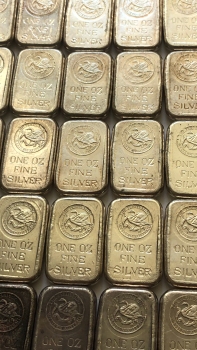
My time at both Delta and Wessex was split between making casting alloys and pouring silver and gold bullion bars. I would say without question that I have made personally over 500,000 troz of silver bullion alone and tens of thousands of ounces of gold bullion bars. We could hardly keep up with the demand. Silver of course was predicted to go to $300.00 troz. Gold went from $35.00 troz to $850.00 troz USD, when Nixon took the U.S. off the gold standard in 1971. I can still remember our excitement when it went from $35.00 to $70.00 in 1972.

Delta had a staff by 1980 of close to 100 people and due to this massive increase in business, saw that it needed to expand. This was to be the beginning of its downfall.

As Delta filled up the building with people and had no more room for equipment, they conceived a plan to have a custom, all inclusive processing plant built. It could take ore in the back door and pump fine gold and silver products out the front. While the idea and concept was good, it was the pace that they tried to expand that was the problem. By the early 80’s they had staggering amounts of metal going through the plant. In one month alone they refined 100,000 troz of silver from scrap, photography and other sources. This was on top of the amount of both placer gold and jewellery scrap, which now was costing 850.00/troz USD, or close to 1,000.00 CDN for gold. This required HUGE cash flow to purchase the gold from miners and jewellers, wages, and run the plant, which was not a cheap proposition.

An English company was hired, TOLLTRECK ENGINEERING, to design the new building, which had been purchased not far from the existing plant. TOLLTRECK was to provide the complete flow sheet of equipment and supply said equipment, from a huge rotary furnace, down to electrolytic silver cells, the works so to speak. The first engineering PROPOSAL cost $250,000.00, no small amount of change in 1981.

Now, as Delta started to have a cash crunch, they started to realize that they did not have enough money to both operate and try to build this Rolls Royce of a plant. So, what do they do, they ask TOLLTRECK to downsize the plant! This of course cost more money, in a time when they could least afford it. We must remember that they had the Alaska operation up and running and while it was a standalone operation, DELTA Vancouver still had to purchase that gold. The first rounds of employee cutbacks happened and some 10% salary reductions!

DELTA also had started a pilot plant to refine mercury and silver from watch batteries, and, a plant to try to recover silver from spent film and x-ray plates. This required the renting of another ware house around the corner with the appropriate staff of trained chemists and lab people. Another expensive proposition.

The banks finally refused to lend any more money, so DELTA then asked TOLLTRECK to cut back on design size again, costing MORE money. This then caused more internal issues with employees, as there seemed to be no real sense of direction. At this point, the fall of 1981 to the spring of 1982, DELTA was some $1.8 million dollars in the hole.

Through this time period two other things were going on. Delta decided it needed to jump into the computer world for accounting, a very new thing back then. A very expensive system was purchased, $250,400 CDN, a main-frame computer that filled a very large room upstairs. It too was a Rolls Royce in its time. Today’s smart phone, which fits in your hand, has twenty times the power of that computer. It brought its own issues of then needing computer people to program it, two were hired. Then as it turned out, it generated so much heat that the room had to be sealed and then it’s own air conditioning system had to be installed. Sealing was critical for both cleanliness and the fact that the air balance from all the exhaust and make up air fans running in the plant, screwed up the computer room. This cost a LOT of money.

Here is the final cruncher for DELTA and ultimately for the customers, especially the placer mining industry. DELTA came up with a scheme to offer to pay interest on metal left on deposit. At the time, DELTA was paying up to 14% on some metal accounts (Bank rate at the time was 11%) with an average of 6%, that added up to a lot of money, but, the kicker was that they then took that very metal on deposit and took it to the bank…and borrowed money against that, to try to keep operating. Then, in 1982, gold and silver dropped, so gold that they had paid $800.+ USD went down to $297.00 USD.

The final death knell came, really not known by very many people, is that a private safety deposit box company in Vancouver had a robbery on a weekend. Through circumstances that even I’m not clear on, a rumour got started that there was an issue at DELTA. This prompted some people to try to get their metal out of DELTA. Secondly, a local coin dealer went out of business and blamed an un-named precious metals refiner, who actually was in Calgary, for his financial problems. People thought it was DELTA, the perfect storm you could say. Due to production scheduling and fine metal allotment on any given day, it was not possible to suddenly hand over fine gold to an unannounced customer arriving at the door. Sure, you could pick it up in a week, but, this got construed as a stall tactic. It did not take long for the placer miner to talk to his fellow miner, which then had the snowball effect. Before you knew it, there was a monstrous run by people wanting their bullion back, or dollars, or BOTH! DELTA was in very serious trouble, with Dave Seed trying to appease people, the very miners that he had gone out into the field and gained their trust, who had left their metal, that it would be safe and SECURE.

An emergency meeting was held, trying to come up with a plan, but, that damage was beyond done, there was no way DELTA could fulfill its obligations. On April 14th, 1983 DELTA filed for a proposal under the bankruptcy act, to be put forth on May 4th, 1983.

The list of creditors was huge, the largest bankruptcy in B.C. at the time, 1,929 people and business’s owed money….$12.59 MILLION to be exact (over 26 Million today). I won’t go into the details of the proposal, as it involves pages of legalese but the bottom line was they wanted to pay back at cents on the dollar and take 6 years to clear everything. It was a sketchy plan at best and with no one willing to lend them more money…or give them metal….it was a done deal.

On May 4th the meeting was held at the Richmond Inn, with over 500 creditors showing up. To say the mood in the room was beyond angry is an understatement. As information came out, there turned out to be less than $500,000 worth of metal in the plant and “possible” liquidation value of only $454,000.00 for all the assets! That turned out to be so far from the truth it was a joke. Stay tuned.

The creditors voted DELTA into oblivion that day, with the R.C.M.P. looking into possible criminal charges. Some of the placer miners that I deal with today lost the most, one family losing over $400,000.00 CDN., another $300,000.00. To this day I still hear the anger in a few voices. Dave Seed had to basically go into hiding and the DELTA staff got tarred with the whole fiasco and they scattered to the four winds.

I had been temporarily re-hired by the AJM Gold Refinery, which had re-named itself PACIFIC REFINERIES.

I too was soon to be back unemployed…but not for long.

The Dismemberment

I picked up the ringing phone (ever notice how my stories start with a ringing phone…weird), listening to the voice on the other end. I hung up, rattled at what I have just been offered to do.

DELTA had now been in mothballs for over 9 months now. A company was hired to do a final clean up of some residual non-precious solutions and the fellow who ran the chemical part of the refinery (Ron Williams) was hired to do a final clean up on any precious metals solutions. Campbell Sharp Limited was the trustee, to look after the bankruptcy and attempt a final sale. The reality was that no one stepped up to buy the place, markets were down, AJM/PACIFIC refineries had blown up, WESSEX was gone, just leaving ENGELHARD, whom were new to the Province then.

Campbell Sharp tried the equivalent of a garage sale on the warehouse where the mercury and silver film equipment was, but that produced very little dollars. Refining equipment is very specialized and no market really existed. What ultimately happened is that Campbell Sharp sucked all the money that was left out of the coffers for the “administration” of the bankruptcy.

Remember I mentioned that DELTA purchased a new main-frame computer? Somehow a financial company in Toronto heard about the computer and that it was virtually brand new….they wanted it. An agreement was made with Campbell Sharp, where the Toronto Company purchased the WHOLE assets in the building for $100,000.00, which of course gave them the main-frame computer, a steal of a deal. At the same time, they had a business interest in Central America, which is what brings me back into the story.

They have somehow tracked me down and ask if I will undertake the dismantling of DELTA, clean up the equipment…and then take it to COSTA RICA to build a small gold refinery there!

I put the phone down, in shock. I was just laid off for the final time from AJM/PACIFIC, had a new baby daughter, and now was asked to enter into this project. I needed the work for sure, but, to go to COSTA RICA for 3 months was a tough decision to ponder. After much discussion with my wife, it was a go, as I could fly back for a few days each month.

In January of 1984 I was given the keys to the DELTA building.

Have you ever seen those post-apocalyptic movies, where one day everyone is going about their business, then, the next day they are GONE! This is what it was like walking into that building, cold, quiet, like a tomb. Almost everything was like it was when they walked out the door 9 months ago. It was weird. I guess that employees were told to grab their personal things and were marched out. I went room to room, not having been here for 5-6 years since I left. Desks still had coffee cups on them, the odd jacket still there, shoes, etc.

As I wandered the building, I started to see what a daunting project this was going to be. Part of my job was to also see about selling anything that would not go to Costa Rica. I had the help of two friends to give me a hand in taking the place apart.

First task was to inventory EVERYTHING, so over the coming few weeks we picked an office that would be a marshaling point for office related things, a room would be filled with calculators, one with scales, one with office supplies, etc.. I looked at the furnace room, deciding in which order the furnaces would be pulled from their position.

Now, while I am doing this, I am very aware of what precious metals might be left, having been involved in all aspects of where they might be lurking, from spills to boil over’s in the furnaces. I half jokingly said in my contract that if I found any “gold bars”, that that would be part of my pay….they agreed to that!

At the same time as we moved office supplies about I decided to make the gold solution precipitation room in the chemical refinery our sand blasting room. All the equipment had rusted quite badly and needed a spruce up; this would be the perfect room, not too big and it had a BIG fan to evacuate the dust. This turned out to be a blessing in disguise.

Each time we moved a desk, we would go through it, which is where the true picture of what happened to DELTA was really revealed. Each person got a memo of course, but, as I worked my way literally to the office of President Dave Seed, there were those memo’s that were for managements eyes ONLY. This is where I started to see the plans and other things that led to the downfall. I put all memos into a box, which I still have to this day. It is too bad that the R.C.M.P. and the investigators did not do this very thing, as it would have filled in so much information right from the start.

Another thing that we found was money, change, loose bills; I think we ended up with around two hundred dollars by the time we went through 50 desks. We basically ended up with the equivalent of a small Staples store in office supplies and gear. To this day I have never had to purchase a pencil, graph paper, etc.. I ended up with a nice desk which I am sitting at as I type this.

I decided to take the gold and silver reactor deck apart first. This was done so I could BURN it. The furnace room had a “crematoria”, something that I had helped put together before I left DELTA. It let us burn jewellers sweeps and at the time, carbon recovery material, that gold mines used. The deck would have trace gold and silver solutions soaked into it so the plan was to render anything and everything that could be melted, to see what we could recover. The reactors would also be the first to be dismantled and cleaned, ready for shipment.

In the furnace room we started to chisel out some of the furnaces, the floors first. This is where any gold or silver would be. The furnaces would be re-lined in Costa Rica, as no sense in shipping the weight of a fully intact furnace; they needed re-building anyhow. All surviving crucibles got flushed out with an appropriate flux.

One day I went into the silver recovery cartridge room. Back in the days of film, both consumer, movie, x-ray, newspapers and the like, silver was used on those films and plates. During the development process, silver is washed off that film into solution. That solution then would pass through a KODAK recovery cartridge, basically a 5 gallon bucket filled with steel wool. An ion exchange would occur, with the silver coming out of solution and the iron going into solution. Once these cartridges had no more iron left, they would be sent for refining. This was a horrible job, as the 5 gallon buckets would have to be opened, the remaining solution drained, then, the sludge would be poured into a large tray, and then those trays put into an oven for drying. It was messy and it smelled of sulphur. I was going to move the drying oven, which was like a baker’s oven. I disconnected the gas and vent lines, then rocked the oven to see how heavy it might be and if I would need a hand. As I rocked the oven up on one side…I realized that it seemed to be recessed into the floor….but that would not be right. As I looked close I realized that I had NOT been walking on a concrete floor, but, a 1” thick carpet of spilled sludge over the years. This should be interesting I thought, knowing full well that the sludge would have silver in it. Our first melt the next day produced a silver bar of virtually 100 troz!

It took us two weeks to dismantle the reactor deck, as six reactors, all the steam piping and fragile glass ware just had to be handled carefully so as to not break any of the glass. We cut the wooden deck up and slowly fed it into the crematoria, taking all of three days to burn it all down to ash. That produced a small gold/silver button when melted.

All the while we had our sand blasting room up and running, the three of us taking turns as the “blaster.” Every bullion mold, pouring tong, grinder, jaw crusher, etc, got cleaned, blasted with sand and then painted. We had segregated the equipment that was to be shipped and had another area where we could have a garage sale so to speak. Other things really were just scrap value.

We were now into our second month of dismantling the place, having sold some office equipment, some of the tools from the maintenance room and other bits and pieces.

One day, as I was working in the furnace room, the building started to rumble and shake, and then a few seconds later a tremendous banging and crashing upstairs occurred, followed by a huge snap as a circuit breaker tripped. What the heck was that? I ran upstairs, into the fan room above our sandblasting room. There as a cloud of rusty dust billowing out the door. What had happened was that after years of gold laden acid fumes having gone up that piping and into the fan, then it sat for 9 months of damp moisture, was, it had finally suffered catastrophic failure and exploded. I let the dust settle and proceeded to check it out, with the realization hitting me that this dust would contain GOLD! Suffice to say I scrapped every bit of material out of the fan and the piping, making sure I cleaned the inside of the fan housing and blades. What a windfall when I melted all that!

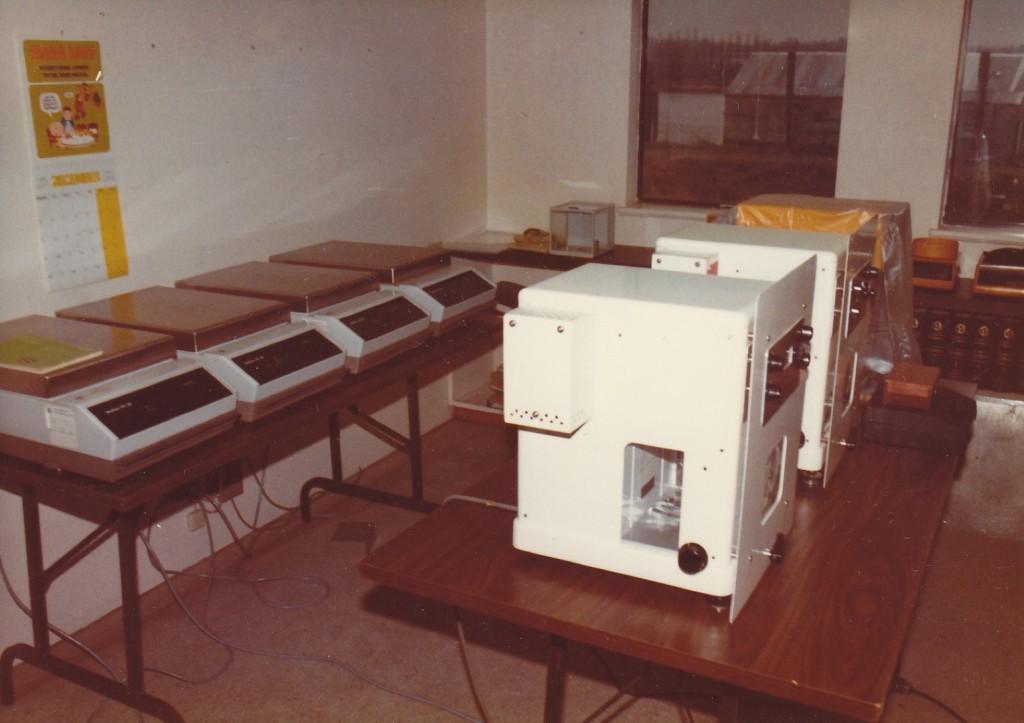
As I left the upstairs fan area, I also noticed a brown wooden case tucked away in a far corner, it had FRAGILE stickers on it. What treasure might this be? I had one of the other guys come and give me a hand to take it downstairs to our clean office area. The lid was well fastened so it took me 5 minutes to undo all the screws. What was it you ask….It was a beautiful antique assay balance, the Rolls Royce of its time, made in the U.S. in the 20’s, that I actually used when we bought it from an old assay lab that closed down in Vancouver in 1971! This scale would have assayed a huge amount from the mines of B.C. in the 1920’s – 1960’s. DELTA had tried sending it back to the manufacturer for refurbishing, but, the cost would exceed the newer digital scales that were starting to come out. DELTA had wanted to send it to the new Alaska operation. It was sent back from the manufacture and sat in this case till I found it. It is now on display as part of my mining collection.

I would get phone calls weekly from the Toronto people, seeing how things were going. At the end of February my contact said there were some issues with the Costa Rican government, not elaborating, but just that things might be put on hold. We had sold most bits and pieces, had all things destined for a small refinery ready to go.

In the middle of March the Toronto head business man came out to Vancouver, to give us the bad news. It turned out that the Costa Rican government, and officials at the time, wanted a lot of money under the table so to speak, to expedite permits, some customs issues and a few other things. The financial company wanted no part of that and pulled out of the deal. Here we go I thought, insanity again in the precious metals world. We were tasked at that point to try to sell off everything that was left. I bought some equipment, as I knew some places where I could re-sell. Engelhard came and bought some reactors and sent them back to Toronto, but, as it turned out, they too had suffered from the down turn in metals and decided to NOT finish the new plant they had built in Tillbury Industrial Park in Delta, B.C..

By April of 1984 DELTA was gutted, what was left gone into storage in Burnaby, where it ultimately went to scrap. DELTA marched on into history, a bitter memory for a lot of miners and jewellers and while it had been a hard decision for me at the time, I’m so glad I did leave.

In the middle of April, 1984, I got another phone call………ENGELHARD and the other person who had left DELTA to start WESSEX with me, needed a qualified melter. On April 24, 1984 I started with ENGELHARD, where I basically am to this day. Engelhard died in the year 2000, but as my office here has always done well financially, as service and HONESTY has been our priority, TECHNIC purchased our office and continues on.

There was no money left to go back to anyone, the Trustees sucked it all up in administration fees. Dave and his Dad, Harry Seed went to court, charged with Criminal Code violations under the Fraudulent Acts sections, but, it was not proven that there was criminal INTENT. The judgment was…and I quote from the Law Digest of B.C., April 30, 1986…

“The defendants were relatively unsophisticated business men with poor management skills and they had been prey to a superficial scheme suggested by others”

Tell that to all the miners and jewellers that lost 12 MILLION DOLLARS……

Keith Law

February 20, 2017

Post Script:

When I started this story some two weeks ago, I must admit that I thought I would have to dig deep to write about more in this Industry. What I did find, as I did my fact checking on dates, etc, to do with Delta, that I have this box of all the things that have blown up in this Industry. In there, which I should have remembered, was the terrible saga of INTERNATIONAL NESMONT Industrial Gold refiners who were found to have brass bars in their vaults. Then there was JAMES METALURGICAL SERVICES INC., another huge scam. GOLDEN WEST REFINING went down when HANDY & HARMON in the U.S. got caught doing some bad stuff. In the U.S. METALOR USA REFINING CORP. Had to pay a huge fine for illegal financial transactions

These companies all were here on the lower mainland, makes you wonder if there was something in the air that brought out the worst in people.

So…it looks like you’re stuck for awhile with me…if you get bored, just let me know.